
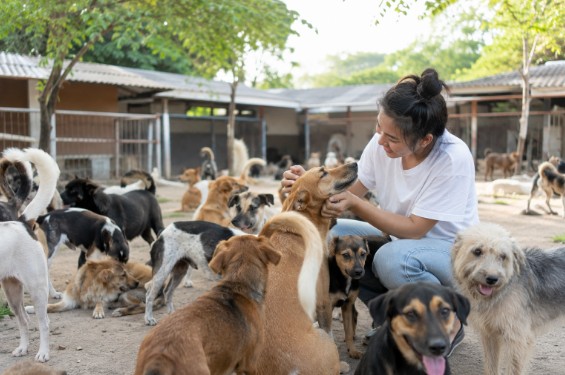
Bali’s shelters hold under 0.5% of the island’s dogs. Here is what the other 99.5% needs.
Millions flow into rescue every year, and the number of Bali street dogs suffering never falls. Endless rescue without mass sterilisation, education, and legal accountability is a treadmill. Here is what the evidence shows, what the law actually requires, and what systemic welfare would look like instead.
The Landscape Nobody Tracks
Every day, social media feeds in major tourist hubs and online communities are flooded with dramatic rescue stories, Wise links, bank transfer details, and urgent appeals for shelter space. Millions of Rupiah flow into saving individual dogs, building sanctuaries, and feeding a cycle of emotional engagement. Yet despite years of continuous rescuing, the number of dogs suffering on the streets never actually decreases.
As a local legal practitioner who directly manages an independent rescue pack on the ground, I see the reality behind the noise. Animal welfare in developing island ecosystems has devolved into a high-visibility competition for social media validation, a model of performative welfare that treats the symptoms of suffering while completely ignoring the cure.
To understand why the money never moves the numbers, it helps to look at who is actually operating. There is no single government registry that tracks every animal rescue effort in Bali, but the operational landscape breaks down into three distinct tiers of organisations and individual care providers.
Major NGOs Operating at Scale
There are 3 to 5 primary, internationally recognised non-profit organisations operating at scale across the island.
- Bali Animal Welfare Association (BAWA): Founded in 2007, operating mobile clinics, emergency hotlines, rehabilitation facilities, and mass sterilisation and vaccination campaigns.
- BARC (Bali Dog Adoption and Rehabilitation Centre): Focuses on sanctuary care, street medical assistance, and adoption programmes.
- Mission Paws’ible (Yayasan Proyek Peduli Indonesia): Operates dedicated healing facilities and targeted rehabilitation.
- Bali Pet Crusaders: Specialises primarily in mobile, free, or low-cost sterilisation and vaccination clinics throughout rural and high-density areas.
Mid-Sized and Private Shelters
Below that tier, there are approximately 15 to 30 formal and semi-formal private sanctuaries and rescue groups registered as local foundations or operating as established non-profits (such as Bali Rumah Singgah Satwa/Bali RuSS, Street Paws, and Bali Paws). These entities usually maintain physical facilities housing anywhere from 20 to 150+ dogs each.

Informal and Independent Rescuers
Beneath both tiers sit dozens, and by some estimates hundreds, of independent, unregistered individual rescuers, local pack caretakers, and expat-run foster accounts operating across the island. This category drives the majority of urgent social media fundraising appeals, Wise and PayPal donation links, and emergency shelter requests.
Shelter Capacity vs. Street Dog Population
Put those three tiers together and the disconnect between heavy financial investment and visible street dog numbers is driven by simple capacity math:
- Total Physical Shelter Capacity: Combined across all major NGOs and private sanctuaries in Bali, total static shelter capacity accommodates roughly 1,000 to 2,000 dogs at any given time.
- Total Street Dog Population: Estimates for free-roaming and village dogs across Bali’s eight regencies and the city of Denpasar range from 300,000 to over 600,000 dogs.
- Coverage Ratio: Physical shelters and sanctuaries house less than 0.5% of the island’s total dog population.
Why Bali Street Dog Numbers Do Not Decrease Through Rescuing
Those two figures never converge, and the reason is structural rather than financial.
Physical shelters quickly reach maximum capacity. Because adoption rates within Bali are low compared to the volume of rescued dogs, shelters frequently become long-term sanctuaries rather than high-turnover adoption pipelines.
Capacity is only half of it. A single unsterilised female dog and her offspring can produce thousands of puppies over several years. Removing individual dogs from the street creates a temporary vacuum quickly filled by new litters.
That leaves the question of systemic impact. Rescuing, hospitalising, and sheltering individual dogs saves specific lives, but it does not lower the overall population density. Population reduction only occurs when vaccination and mass sterilisation (Catch, Neuter, Vaccinate, Release / CNVR) rates exceed the natural reproduction rate across entire districts.
The truth is simple: you cannot adopt, shelter, or crowdsource your way out of a population crisis. True animal welfare requires the unglamorous, systemic work of mass sterilisation, strict legal enforcement under Indonesian law, and holding owners accountable. Until we stop celebrating the illusion of rescue and start enforcing the law, we are merely subsidising a problem we claim to fight.

Legal Classification vs. Field Activity
There is a second reason the picture stays blurred, and it has nothing to do with capacity. It is how these operations are classified on paper.
The focus here is specifically on active rescue operations, the physical picking up, emergency treating, and housing of individual street animals, because that is where the divide between official legal status and untracked field activity is widest.
The Ministry of Law and Human Rights (AHU) registers legal entities based on generic corporate or non-profit structures (such as a Yayasan for social and humanitarian purposes, or a CV for professional services). The government does not tag, classify, or track entities under a specific functional label like “animal rescue.”
Rescue vs. Systemic Solutions
That distinction matters because physical “rescue” (operating a shelter or taking in street dogs) is only one operational approach. Major registered organisations and specialised groups often prioritise systemic prevention, such as mobile sterilisation (CNVR), mass rabies vaccinations, community education, and legal or policy advocacy, over building physical shelters.
Why Informal Rescues Stay Invisible
At the informal tier, the classification gap widens into a blank space. Groups focusing exclusively on individual street rescues often operate entirely as unregistered networks. Because they do not incorporate as a Yayasan, file tax returns with DJP, or secure permits from Dinas Sosial, their rescue activities, dog counts, and financial collections exist completely outside official government data. Registered entities show up in public and legal records because of their formal legal structure, not because the state maintains an “animal rescue” directory.
Legal Advocacy and Systemic Protection: CV Dharma Shield Bali
That leaves a gap between the registered organisations that do not enforce and the informal rescuers who cannot. This is where my own work sits, and it is time people knew what it consists of.

Filling the missing link between direct physical rescue and legal enforcement, CV Dharma Shield Bali (DSB) (AHU-0064163-AH.01.14) operates as a registered commercial and legal consulting entity designed to tackle root causes rather than managing endless shelter capacity.
- Banjar and Customary Law (Pararem) Integration: Drafting and establishing binding local village regulations (Pararem Banjar) that mandate dog sterilisation, enforce owner accountability, and legally outlaw poisoning and abandonment across local communities.
- Legal Enforcement and Dispute Mediation: Applying formal legal consultation and mediation to resolve animal-related community conflicts, property disputes, and animal cruelty violations under Pasal 337 of the Indonesian Criminal Code (UU No. 1 Tahun 2023).
- Targeted Sterilisation and Protection Advocacy: Partnering with local leaders, NGOs, and charities to drive high-volume sterilisation and rabies control directly in target villages, keeping dogs safe within their natural territories instead of overcrowding shelters.
- Community Legal Education: Educating pet owners, village officials, and local communities on legal owner liabilities, animal rights, and humane population control methods.
- Self-Sustaining Funding Model: Reinvesting revenue generated from professional legal and mediation services directly into animal advocacy programmes, maintaining full independence without relying on unstable donation cycles or non-existent government subsidies.
The Treadmill
Independence from the donation cycle matters because of what that cycle actually rewards. Many rescue groups operate on a donor-driven model that prioritises individual “heroic” saves over systemic prevention. This creates an echo chamber where rescuers compete for clout, funding, and sympathy rather than tackling root causes. Crowdfunded altruism subsidises individual saviours while starving the ground-level, local infrastructure that is mathematically required to end street dog suffering for good.
Sheltering and endless intake without mass sterilisation is mathematically incapable of reducing stray populations. The vacuum effect explains why: removing a few dogs from a territory without sterilising the rest simply creates space for new unsterilised litters to survive and take over.

International standards say the same thing. Chapter 7.7 of the WOAH Terrestrial Animal Health Code (titled Dog Population Management) frames effective programmes as a combination of measures that influence dog population dynamics, noting that herd immunity is supported by improving the survival of vaccinated dogs and reducing the birth of unvaccinated puppies through surgical sterilisation.
Key Takeaway: Removal is not the mechanism of population control. Reproduction is.
Case Study: The 96-Hour Mirror, Crisis Cash vs. Prevention Silence
None of this is abstract. Inside active rescue messaging groups, the disparity between emotional reaction and systemic prevention plays out in real time every week:
- The Emergency Rush: A post detailing a single sick or injured street dog can generate over Rp 3,500,000 in pledges within hours. Overseas donors wire funds via instant transfer apps, celebrating the immediate “save” with heart emojis, while clinic estimates, often padded with unverified charges like transport or darting fees, are funded without audit.
- The Sterilisation Silence: In that exact same chat group, dropping a link or call to action for mass sterilisation (CNVR) yields near-total silence. No pledges, no engagement, and no urgency.
- The Psychological Trap: Emergency rescue provides an instant, photogenic payoff. A picture of a rescued dog creates the illusion of a problem solved. Sterilisation provides a statistical result, a litter of puppies that was never born onto the street.
Because an unborn litter cannot be photographed for social media, the rescue economy actively starves the very intervention mathematically required to end street suffering.
The Herd-Level Effect
What donors are declining to fund is not simply one option among several. It is the only intervention whose effect reaches past the dog it is performed on.
The fundamental flaw of case-by-case rescue is its reliance on isolated impact. Saving one dog at a time benefits only that one dog. Systemic population control operates on an entirely different scale.
Research by Yoak et al. (2014) on street dog populations demonstrated that animal birth control (ABC/CNVR) programmes create a profound herd-level effect. The secondary health and disease control benefits of mass sterilisation extend across the entire community, directly improving the survival, body condition, and health of untreated street dogs that no rescuer ever touched.
No amount of individual crowdfunding, sheltering, or social media adoption campaigns can ever produce a herd-level result. Mass sterilisation does not just manage numbers, it elevates the health of an entire ecosystem that shelters simply leave behind.

A Public Health Problem, Not a Welfare Hobby
The consequences do not stop at the dogs. When rescue culture focuses on hoarding individual cases rather than systemic population control, the community pays the price. An unmanaged street population is not just an animal welfare issue, it is a public safety hazard that perpetuates endemic rabies cycles and community conflict. We cannot shelter our way out of a public health risk.
The evidence base is not local to any one island. Cohort studies of free-roaming dogs in Bali and South Africa have shown that high population turnover, driven by births of unvaccinated puppies and deaths of vaccinated adults, is the central obstacle to maintaining protective coverage between campaigns. Sporadic culling and uncoordinated removal make turnover worse, not better. The pattern repeats wherever it is measured because it is driven by reproduction rather than by geography.
Real solutions require grounding welfare in local law: enforcing responsible ownership, penalising abandonment, and committing to high-density sterilisation until the streets are finally quiet.
Case Study: Donor Geo-Fencing, When Boundaries Sabotage Epidemiology
Density is exactly what donor conditions tend to break. Even when larger organisations undertake sterilisation, they frequently allow foreign sponsors to dictate arbitrary geographic boundaries, funding one village while excluding an adjacent street barely 400 metres away.
Dogs do not respect administrative borders. Free-roaming dogs move, mate, and shift territory constantly across sub-district boundaries. Excluding neighbouring areas therefore creates reservoir pockets, leaving unsterilised populations that breed and migrate back into the treated zone, triggering the vacuum effect and completely neutralising the campaign’s impact.
The ultimate victims are the dogs in the excluded “unfavourite” zones, who remain exposed to mass culling, rabies transmission, and the dog meat trade simply because systemic prevention was denied based on donor preference.
The Law Already Exists
Donor preference can only dictate coverage where nothing else does, and in Indonesia something else already does. The gap in animal welfare here is not legislative. It is enforcement.

Under Undang-Undang Nomor 18 Tahun 2009 (as amended by Undang-Undang Nomor 41 Tahun 2014), animal welfare is a statutory duty rather than a moral preference. Pasal 66 and Pasal 66A establish mandatory obligations covering the treatment, handling, and care of animals, prohibiting abuse that leaves an animal disabled or unproductive.
Criminal liability sits alongside it. Under the Criminal Code, Undang-Undang Nomor 1 Tahun 2023 (KUHP), the animal cruelty provision formerly at Pasal 302 KUHP now sits at Pasal 337.
- Basic Cruelty: Hurting, injuring, or damaging an animal’s health without proper purpose, or engaging in sexual acts with an animal, carries up to 1 year imprisonment or a Category II fine.
- Severe Harm: Where the act causes the animal to fall sick for more than a week, become disabled, suffer serious injury, or die, the penalty rises to 1.5 years imprisonment or a Category III fine.
- Confiscation: Where the animal belongs to the offender, the court may order its confiscation.
Abandonment, neglect, and cruelty are therefore already actionable under national law. What is missing is the will to use the legal framework, and a rescue culture that treats enforcement as somebody else’s job while raising funds to absorb the consequences.
The Common Thread
A crowdfunded rescue that changes no system, a sterilisation campaign fenced off at a village boundary, and a cruelty offence that nobody reports all fail for the exact same reason.
Each one looks like action. Each one produces something that can be shown: a photograph, a transfer receipt, a completed campaign report. None of them is measured against a verified outcome, so none of them can ever be shown to have failed.
Systemic welfare is the exact opposite:
- Count the dogs.
- Sterilise at density.
- Cover whole territories, not funded fragments.
- Enforce the laws that already exist.
It generates no social media applause, but it is the only thing that has ever worked.
Sources and References
International and Institutional Guidelines
- WOAH Terrestrial Animal Health Code, Chapter 7.7 (Dog Population Management). Global standards framing effective programmes as a combination of surgical sterilisation, registration, and responsible ownership, with herd immunity supported by reducing the birth of unvaccinated puppies rather than by removing dogs.
- ICAM Coalition, Humane Dog Population Management Guidance | Direct 2019 Guidance PDF. Standards specifying that dog population management must combine high-density sterilisation, legal registration, and community education rather than localised sanctuary collection.
- FAO One Health, Reducing Human Rabies Cases in Bali. Field data from Bali showing that mass vaccination and health management of free-roaming dogs, rather than removal or culling, is what broke the transmission chain.
Scientific Research
- Yoak, A. J., Reece, J. F., Gehrt, S. D., and Hamilton, I. M. (2014). Disease control through fertility control: secondary benefits of animal birth control in Indian street dogs. Preventive Veterinary Medicine, 113(1), 152 to 156. doi.org/10.1016/j.prevetmed.2013.09.005
- Morters, M. K., et al. (2014). The demography of free-roaming dog populations and applications to disease and population control. Journal of Applied Ecology, 51(4), 1096 to 1106. doi.org/10.1111/1365-2664.12279. Three year cohort study across Bali and South Africa quantifying how births, deaths, and movement drive population turnover.
- Collins, L. M., et al. (2025). Changes in free-roaming dog population demographics and health associated with a catch-neuter-vaccinate-release program in Jamshedpur, India. PLOS ONE, 20(10), e0317636. journals.plos.org/plosone/article?id=10.1371/journal.pone.0317636. Evaluation of a programme covering more than 20,000 dogs, finding population decline only where neutering coverage was sustained at 65% and above.
- Arief, R. A., et al. (2017). Determinants of vaccination coverage and consequences for rabies control in Bali, Indonesia. Frontiers in Veterinary Science, 3, 123. doi.org/10.3389/fvets.2016.00123 | Full text. Shows how unvaccinated puppies and free-roaming dogs undermine campaign coverage.
Indonesian Legal Framework
- Undang-Undang Nomor 1 Tahun 2023 (Kitab Undang-Undang Hukum Pidana), JDIH BPK RI. Pasal 337 replaces the former Pasal 302 KUHP on animal cruelty.
- Undang-Undang Nomor 18 Tahun 2009 jo. UU No. 41 Tahun 2014 (Kementan PDF). Pasal 66 and Pasal 66A on animal welfare duties.
Population and Epidemiological Studies
- WOAH Asia-Pacific, Estimating Dog Population in Bali for Rabies Control. WOAH project and methodology for estimating owned and free-roaming dog populations in Bali.
- Townsend, S. E., et al. (2013). Designing programs for eliminating canine rabies from islands: Bali, Indonesia as a case study. PLoS Neglected Tropical Diseases, 7(8), e2372. journals.plos.org/plosntds/article?id=10.1371/journal.pntd.0002372. Finds that omitting even areas holding under 0.5% of the dog population jeopardised elimination, the peer-reviewed basis for the geo-fencing argument.
Major Bali NGOs and Foundations
- BAWA (Bali Animal Welfare Association)
- BARC (Bali Dog Adoption and Rehabilitation Centre)
- Mission Paws’ible (Yayasan Proyek Peduli Indonesia)
- Bali Pet Crusaders
Indonesian Legal and Government Portals
- AHU Online (Direktorat Jenderal Administrasi Hukum Umum). Official Kemenkumham portal for legal entity registration status (Yayasan, CV, PT).
- DJP Online (Direktorat Jenderal Pajak). Official tax portal for corporate NPWP management and annual filings (SPT Tahunan Badan).