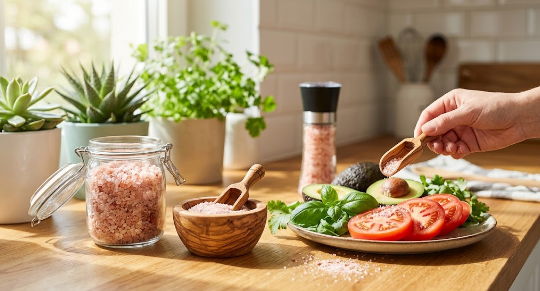
I have a jar of pink Himalayan salt on my counter. That is not a disclaimer, it is the reason I went looking.
Pink Himalayan salt gained massive popularity primarily due to its distinct visual appeal and aggressive wellness marketing, despite being chemically nearly identical to standard table salt. Most of what follows is what you would find anywhere. The last part is not, and it is the only part that might change what is in your kitchen.
So, What’s Behind the Hype?
- Aesthetic and Culinary Appeal: Its soft pink hue, caused by trace iron oxide, makes food visually striking, while coarse crystals provide a pleasant crunch as a finishing salt.
- “Pure and Unprocessed” Branding: It is heavily marketed as an ancient, natural rock salt harvested without synthetic anti-caking additives or heavy industrial processing.
- Lifestyle and Spa Trends: Beyond cooking, it flooded the market through salt lamps, bath soaks, and salt-cave therapies, creating an aura of holistic wellness.
A Little Trivia: Geological Origins, Where Pink Himalayan Salt Actually Comes From
The pink Himalayan salt beds formed over 500 million years ago when an ancient sea evaporated, later sealed underground by tectonic shifts in the Salt Range of Punjab, Pakistan. Historical legend credits Alexander the Great’s army with finding the salt around 326 BC, when their horses were spotted licking salty rocks during the Indian campaign. Local extraction continued through the Mughal Empire, but large-scale tunnel mining began in 1872 under British rule at the Khewra Salt Mine.
The global popularity of Pink Himalayan salt then unfolded across three distinct phases:
- 1980s to 1990s (Niche Specialty Item): Sourced from the Salt Range in Punjab, Pakistan (primarily the Khewra Salt Mine), pink rock salt was initially imported into North America and Europe in small quantities as an exotic gourmet culinary ingredient or decorative mineral specimen.
- 2001 to 2003 (The Catalyst Phase): The trend exploded in German-speaking Europe following the publication of alternative health books promoting “Himalayan crystal salt” as a miracle therapeutic substance.
- 2008 to Present (Global Mainstream Expansion): The product migrated heavily into North America and global markets through boutique wellness stores, high-end grocery chains, and lifestyle influencers. By the mid-2010s, its application expanded beyond cooking into salt lamps, spa halotherapy rooms, and bath products, creating a multi-million-dollar industry.

Who Started the Hype?
The commercial push behind pink Himalayan salt originated from alternative health marketers in Europe during the early 2000s. They are Peter Ferreira and Dr. Barbara Hendel. Peter Ferreira (a self-styled biophysicist and entrepreneur) and Dr. Barbara Hendel (a German physician) co-authored the 2001 book Wasser & Salz: Urquell des Lebens (Water & Salt: The Essence of Life).
There, the “84 Minerals” narrative began. Ferreira and Hendel claimed that unrefined Himalayan rock salt contained “84 essential trace elements in elemental form,” matching the elements found in the human body and ancient primal seas. They marketed a saturated salt solution called Sol-é as a cure-all capable of restoring body frequencies, balancing cellular pH, and flushing out heavy metals.
For the cherry on top came the commercial exploitation. Alongside the book, commercial ventures launched under brand names selling Himalayan rock salt at markups up to 20 to 30 times higher than regular table salt. Multi-level marketing distributors, natural product trade shows, and wellness media subsequently amplified these claims worldwide.
Deconstructing the “Healthier Salt” Jargon
The lovely packaging of “84 Trace Minerals” comes first. Marketing materials often highlight that pink Himalayan salt contains dozens of trace minerals like potassium, magnesium, and calcium. While true, these minerals exist in microscopic fractions. You would have to eat a dangerous amount of sodium daily to obtain a functional dose of any mineral from pink salt.
Then come the “Detoxification and pH Balancing” claims. Claims that pink Himalayan salt balances body pH, flushes out toxins, or improves sleep are health claims unsupported by peer-reviewed medical science. The human kidneys and lungs naturally regulate internal body pH.
Also the “Lower Sodium” myth. Gram for gram, pink Himalayan salt contains virtually the exact same amount of sodium chloride (about 97% to 98%) as standard table salt. It only delivers slightly less sodium per teaspoon because coarse crystals leave more empty space in a measuring spoon than fine table salt.
Scientific and Medical Studies: Accurate Findings
Peer-reviewed chemical analyses, nutritional evaluations, and public health reviews consistently refute the health claims associated with pink salt.
1. The Australian Mineral and Safety Study (Fayet-Moore et al., 2020)
Published in the peer-reviewed journal Foods in October 2020 by researchers from Nutrition Research Australia working with Bond University, Southern Cross University, and others:
- Study Design: A mass spectrometry scan evaluating 25 essential and non-essential minerals across 31 commercially available pink Himalayan salt samples compared to an iodised white table salt control.
- Nutritional Reality: While pink Himalayan salt contained measurable amounts of minerals like calcium, magnesium, potassium, and iron, the quantities were biologically negligible.
- Quantity Paradox: Researchers calculated that a person would need to consume over 30 grams of pink salt per day (approximately 6 teaspoons) to obtain any meaningful contribution to daily recommended nutrient intakes. Consuming 30 grams of salt would deliver over 6 times the World Health Organization’s recommended daily limit of less than 5 grams, causing severe cardiovascular harm.
- Contamination and Lead Levels: Non-nutritive heavy metals were detected across multiple samples. Notably, one pink salt sample, sourced from Peru rather than the Himalayas, contained lead levels exceeding 2.0 mg/kg, surpassing the legal national maximum contaminant threshold set by Food Standards Australia and New Zealand.

2. Chemical Analysis of the “84 Minerals” Claim
The previous section addressed what the claim asks you to believe. This is what happens when the salt goes under a spectrometer.
- Base Composition: It is composed of 96% to 98% sodium chloride (NaCl).
- Pigmentation Source: The trademark pink hue comes primarily from microscopic inclusions of iron oxide (rust particles), not a unique health-promoting compound. Traces of manganese and copper compounds may also contribute, and German testing has raised the possibility of microscopic algae playing a part.
- Inclusion of Toxic Elements: The marketed list of “84 elements” includes non-nutritive, radioactive, or toxic elements such as uranium, radium, polonium, lead, cadmium, and arsenic, present in trace, sub-nanogram quantities.
3. Regulatory and Legal Verdicts on Health Claims
European regulatory agencies and courts formally evaluated the claims made during the peak of the marketing surge:
- Bavarian State Office for Health and Food Safety (Germany): Tested 15 different samples of commercial “Himalayan crystal salt” and found it consisted of roughly 98% sodium chloride. Against the 84 minerals promised, the laboratory identified only eight further minerals beyond sodium and chloride, ten elements in total, most of them present only in the smallest traces. The office stated that no special effects are associated with either the origin or the colour of the salt.
- German Consumer Association (Verbraucherzentrale): Issued consumer warnings confirming that Himalayan salt offers no medical or nutritional advantages over standard table salt, that it cannot meet daily mineral requirements apart from sodium and chloride, and that unlike iodised table salt it contributes nothing to iodine supply. The association cautioned consumers against paying inflated prices based on unsubstantiated health promises.
- The German Federal Court of Justice (Bundesgerichtshof), 31 March 2016, case I ZR 86/13: Germany’s highest civil court ruled that describing a product as culinary salt “from the region of the Himalaya” misleads the informed average consumer about its geographical origin, because the salt is not mined in the high Himalayan massif but in the Salt Range, a mid-altitude range in the Pakistani province of Punjab. The court held that it was entirely possible and reasonable for the seller to prevent that misconception by clearly describing the actual mining area, or by using names such as Kaisersalz or Alexandersalz. The ruling upheld the decision of the Higher Regional Court of Cologne and confirmed that an online retailer is liable as principal for a listing published in its own name, even where the product presentation was supplied by a third party.
That last verdict is worth sitting with. It is not a nutritionist disagreeing with a marketer. It is a supreme court finding that the name on the jar was misleading enough to be unlawful.
Those verdicts all address what pink salt fails to deliver. There is one thing standard table salt delivers that almost nobody buys it for, and this is where the switch stops being a matter of taste and price.
Universal Salt Iodisation
Salt iodisation is simply the process of adding a tiny amount of essential iodine to everyday table salt to protect public health.

Why salt was chosen. Everyone eats salt every day, regardless of their income level. Adding iodine does not change how salt looks, smells, or tastes, making it the easiest way to get iodine into everyone’s diet without forcing people to change their cooking habits.
How it is made. During factory refining, workers spray or mix a tiny, exact amount of an iodine compound, typically potassium iodate (KIO3) or potassium iodide (KI), into purified table salt, roughly 20 to 40 milligrams of iodine per kilogram of salt.
The health result. Supported by global agencies like the WHO and UNICEF, this simple step successfully wiped out severe iodine deficiency diseases worldwide, especially in regions where the local soil and food naturally lack iodine.
The Physiological Role of Iodine in Thyroid Health
The human thyroid gland requires elemental iodine as a mandatory building block to synthesise two vital metabolic hormones: thyroxine (T4) and triiodothyronine (T3).
The mandatory dietary supply is the first point. The human body cannot manufacture iodine internally, so it must be obtained entirely through diet.
The hormonal regulation is the second. T3 and T4 regulate fundamental biological processes, including basal metabolic rate, body temperature, heart rate, brain development, and cellular repair.
The recommended daily intake of iodine for an adult is approximately 150 micrograms, increasing to 220 to 290 micrograms during pregnancy and lactation.
To get 150 micrograms of iodine from standard iodised table salt, you need roughly 1/4 to 1/2 teaspoon, or less than 1/6 of a tablespoon. Here is the breakdown:
Adult Recommendation (150 Micrograms)
- In Teaspoons: Depending on regional fortification levels, standard iodised table salt contains between 150 and 280 micrograms of iodine per teaspoon. Eating just 1/4 to 1/2 teaspoon of iodised salt covers 100% of an adult’s daily requirement.
- In Tablespoons: Since 1 tablespoon equals 3 teaspoons, 150 micrograms is a tiny fraction, about 1/6 of a tablespoon.
Pregnancy and Lactation Recommendation (220 to 290 Micrograms)
- In Teaspoons: This higher target equals about 3/4 to 1 full teaspoon of iodised salt per day.
- Why doctors do not recommend eating more salt: Health organisations advise against increasing salt intake during pregnancy, as 1 full teaspoon of salt reaches the maximum safe daily limit for sodium. Instead, the extra iodine is typically covered by prenatal vitamins or iodine-rich foods like eggs, dairy, and seafood.
So the maths and the medical advice point in opposite directions, and both are correct. It looks like a contradiction on the surface, but it represents a clash between mathematical conversion and medical safety.
The maths (iodine target). The calculation of 3/4 to 1 teaspoon of salt shows what is mathematically required. If iodised salt were a woman’s only source of iodine during pregnancy, that is the exact volume of salt needed to hit 220 to 290 micrograms of iodine.
The medical limit (sodium danger). One teaspoon of table salt contains approximately 2,300 milligrams of sodium, the absolute maximum recommended daily limit for an adult. Eating 1 full teaspoon of salt just to hit the iodine goal pushes sodium intake to the maximum ceiling, raising the risk of high blood pressure, excessive fluid retention, and preeclampsia during pregnancy.

The resolution. Because eating that much salt is unsafe for blood pressure, doctors do not want pregnant women using salt to close the iodine gap. Instead, guidelines advise keeping salt intake moderate and getting the extra required iodine safely through prenatal vitamins, eggs, dairy, or seafood, food sources that deliver iodine without adding extra sodium. This is not a flaw in the system. The WHO itself notes that salt reduction and salt iodisation are compatible, and that fortification levels are meant to be adjusted as populations eat less salt.
Impact of Switching Entirely to Non-Iodised Pink Salt
Mined Himalayan pink salt naturally contains negligible amounts of iodine and does not undergo public health fortification. Replacing all table salt with non-iodised pink salt removes the primary dietary safety net for iodine, triggering specific physiological consequences:
- Goitre Formation: When iodine intake falls, T3 and T4 levels drop. The pituitary gland responds by overproducing Thyroid-Stimulating Hormone (TSH) to force the thyroid into hyper-drive. This continuous TSH stimulation causes the thyroid tissue to overgrow, resulting in a visible neck mass known as a goitre.
- Clinical Hypothyroidism: Without sufficient iodine to build hormones, the body’s metabolic rate slows down. Symptoms include chronic fatigue, unexplained weight gain, muscle weakness, depression, cold intolerance, and impaired memory.
- Risks During Pregnancy: Maternal iodine deficiency severely threatens fetal brain development. Inadequate iodine during gestation can lead to irreversible cognitive impairment, growth stunting, and congenital thyroid disorders in newborns.
- Inadequate Natural Levels: Relying on the trace minerals in pink salt to cover iodine needs is biologically ineffective, as raw rock salt contains less than 1% of the iodine present in fortified table salt.
What This Means in Indonesia
None of this is abstract here, because Indonesia treats iodised salt as a legal obligation rather than a lifestyle preference.
Salt sold for consumption must meet the Indonesian National Standard (SNI), which requires a potassium iodate content of 30 to 80 ppm. Beyond the product standard, Peraturan Menteri Dalam Negeri Nomor 63 Tahun 2010 places binding duties on regional governments to control Iodine Deficiency Disorders (GAKY), and it directs regions to regulate against the circulation of non-iodised salt, to raise public awareness, and to coordinate monitoring at provincial and district level.
The gap between the rule and the shelf is the familiar part. National survey data has shown roughly 77% of the population consuming salt that meets the standard, with around 8% consuming salt containing no iodine at all. Some products carry an iodised label while testing at zero. So the safety net exists in law, it is imperfect in practice, and choosing to step outside it deliberately is a different decision here from what it would be in a country where iodine reaches people through other foods.
Unlike standard table salt, pink rock salt is not iodised. Swapping entirely to pink salt eliminates a major dietary source of iodine, which is critical for thyroid function. How much of this did you already know? If the answer is not much, you are in the majority.
Nutritionally, it is essentially the same as table salt. Both are around 97 to 98% sodium chloride, and the trace minerals in pink salt (iron, potassium, magnesium, calcium) are present in quantities far too small to make any real difference to your intake. You would have to eat a dangerous amount of salt to get a meaningful dose.

Although, coarser crystals mean slightly less sodium per teaspoon by volume, so it can help a little if you measure by spoon rather than weight. Unfortunately, most of us do not do this. Like me. Personally, I use simply feeling. My brain is too tired keeping track of how many spoons for this dish and that soup. It is also less processed, with no anti-caking agents. Additionally there is the flavour and texture, which many people prefer for finishing dishes. But this is one’s own preference.
What we have to understand is that pink Himalayan salt is usually not iodised. This matters especially in Indonesia, where iodised salt is a public health measure against goitre and iodine deficiency. If you switch entirely to pink salt, you lose that source unless you get iodine from seafood, eggs, or dairy. The cost? Of course, pink Himalayan salt is much more expensive for the same thing. The health claims about detoxing, balancing pH, or improving sleep are marketing, not science. Not to mention that some pink salts contain trace heavy metals, though at normal consumption levels this is not considered a concern for an individual eating normally, while the researchers themselves called for regulators to look at it across the market.
A reasonable middle ground: keep iodised salt for everyday cooking and use pink salt for finishing if you like the taste and texture.
It is the same shape as the rescue economy I wrote about recently, in a completely unrelated field. Something that produces the feeling of having done the right thing, with no step anywhere in it where anybody checks whether it worked.
Sources and References
Scientific Research
- Fayet-Moore, F., et al. (2020). An Analysis of the Mineral Composition of Pink Salt Available in Australia. Foods, 9(10), 1490 | DOI. Mass spectrometry analysis of 31 pink salt samples against an iodised white salt control, covering 25 nutritive and non-nutritive minerals.
- Nutrition Research Australia, world-first study on pink salt composition. Summary of the study findings from the funding body.
German Regulatory and Legal Findings
- Bayerisches Landesamt für Gesundheit und Lebensmittelsicherheit, on culinary salt. The Bavarian State Office position that no special effects are associated with the origin or colour of Himalayan salt.
- Verbraucherzentrale, “Himalaya-Salz, was steckt dahinter?”. Consumer association analysis, including the finding of only eight additional minerals against the 84 claimed, and the absence of any iodine contribution.
- Wettbewerbszentrale summary of BGH judgment of 31 March 2016, case I ZR 86/13. Plain-language account of the ruling on misleading geographical origin.
- Full text of the Bundesgerichtshof judgment, I ZR 86/13 “Himalaya Salz”, WIPO Lex. The complete decision, including the finding on online retailer liability
World Health Organization
- WHO fact sheet, Sodium reduction. The recommendation of less than 2,000 mg of sodium, equivalent to less than 5 g of salt, per day for adults.
- WHO Guideline: Sodium Intake for Adults and Children, recommendations and remarks. Includes the statement that salt reduction and salt iodisation are compatible and that iodisation levels should be monitored and adjusted.
Indonesian Standards and Regulation
- Peraturan Menteri Dalam Negeri Nomor 63 Tahun 2010 on regional GAKY control. Duties of regional government on iodised salt production, distribution, consumption, and preventing circulation of non-iodised salt.
- Kementerian Kesehatan, on the proper use of iodised salt. Ministry of Health guidance on iodine fortification and daily requirements.
- Badan Standardisasi Nasional, on the importance of SNI-certified iodised salt. The national standard for iodised consumption salt and its enforcement.
- Nutrition International Indonesia, landscape of iodised salt fortification. The 30 to 80 ppm SNI requirement, regulatory monitoring gaps, and national survey figures on compliance.