

Category: The Vault

  • The Sovereign’s Illusion: When Guests Colonize the Host

    The Sovereign’s Illusion: When Guests Colonize the Host

    Exposing the Anatomy of Extractive Tourism and Guest Entitlement

    In any sovereign nation, the relationship between a host and a guest is governed by an unwritten contract of mutual respect and legal compliance. When you travel abroad, you adapt to the host country; you do not demand that the host country adapt to you. Yet in specific global epicenters like Bali, this foundational logic has completely broken down, replaced by a system of extractive tourism.

    For decades, local warmth and hospitality have been misinterpreted as submission. Today a staggering shift is occurring in hotspots like Canggu and Uluwatu: foreign guests are no longer just visiting, they are actively constructing insular enclaves that systematically exclude the local population from their own land. When basic structural regulations or immigration laws are introduced, these communities react not with compliance, but with defensive outrage. This is not a mere cultural misunderstanding; it is a modern mutation of historical colonialism, wearing the casual attire of digital nomadism.

    The Psychology of the “Stateless Elite”

    To understand how a guest begins to act like an owner, we must look into the socio-economic distortions created by “mobility capital.” Sociologists use this term to describe how a powerful Western passport grants individuals unequal freedom of movement and disproportionate leverage when entering developing nations. The passport does not simply open a border. It sets the terms on which its holder arrives.

    The Transnational Lifestyle Privilege.

    When expatriates engage in geoarbitrage, earning in a dominant currency like USD or EUR while spending in a weaker local currency, they do not just arbitrage prices. They arbitrage social hierarchies. In nomad networks, this is often celebrated as “lifestyle freedom.” However, sociologists studying lifestyle migration note that this dynamic creates a psychological distortion: the migrant mistakes their financial advantage for a form of systemic exemption. They demand the legal protections of a functional host state, yet expect the unregulated freedom of a personal playground.

    Extractive tourism in Bali: crowded beach club strip in the south of the island

    The Hostility Toward Enforcement

    This explains why legal immigration crackdowns, such as the recent government actions targeting unauthorized foreign businesses and illegal digital commerce, are met with defensive shock. When an individual views a host country merely as an aesthetic backdrop for their personal lifestyle migration, basic law enforcement feels like a personal violation.

    The underlying logic is extractive: they believe that their financial contribution to the local economy grants them a temporary waiver from local sovereignty.

    The Mechanics of Digital Enclaving

    That waiver is never requested out loud. It is built quietly into the ground, into the pricing, and into who is made to feel welcome. The modern expatriate crisis does not look like traditional military occupation. It functions through spatial and digital enclaving, which systematically prices out and isolates the local host community.

    Infographic contrasting the digital nomad enclave with the local host community in Bali

    Two worlds, one place. The contrast between the Digital Nomad Enclave and the Local Host Community shows how global capital and expat ecosystems can occupy the same island while diverging entirely from local realities. The color split makes the socio economic divide instantly visible, and the downward arrows trace the structural flow of exclusion and displacement.

    Building an “Ally” Inside Someone Else’s Home

    When these groups settle in hotspots like Berawa or Uluwatu, they immediately establish parallel socioeconomic networks. They build expat-targeted gyms, co-working spaces, and exclusive run clubs that operate entirely in English or in other foreign languages, and they utilize digital platforms that locals rarely access.

    By conducting trade, networking, and socialization exclusively within their own circle, they form an alliance inside someone else’s home. Locals are pushed out of these spaces, not always by physical force, but through high prices and a welcoming attitude reserved only for other foreigners.

    The Illusion of Integration

    What results is a highly curated form of segregation. The foreigner wants to enjoy the tropical climate, the affordable lifestyle, and the cultural charm, but they intentionally avoid the civic responsibilities that come with living in a community. They want the benefits of the space without showing any accountability to the people who protect and maintain it.

    The Rentier Class and Urban Extractivism

    Segregation of this kind is not sustained by attitude alone. It has an engine. The core conflict in modern overtourism is found in the economy: the demand for local costs paired with an expectation of special privilege. This dynamic is the very definition of Urban Extractivism, and it is the financial engine of extractive tourism.

    The Parasitic Financial Model

    A troubling economic trend involves foreign entities setting up front companies or using proxy arrangements to control local real estate and commercial sectors. These operations extract substantial wealth from the local economy, yet they route the profits through offshore accounts or digital platforms based in the West.

    The mechanism runs in three steps. The extraction step: they pay low, local-tier wages to domestic service staff. The hoarding step: they charge premium, Western-tier prices to other expatriates. The result: the host country provides the physical space, the infrastructure, and the labor, while the actual wealth is siphoned away.

    What makes this model precarious is that none of it stands on solid ground. While expatriates aggressively build exclusive venues, their control of the underlying real estate frequently relies on unlawful nominee arrangements. Under the Indonesian Basic Agrarian Law (UU No. 5/1960, Pasal 21 and Pasal 26 ayat 2), borrowing a local citizen’s name to acquire land is null and void, batal karena hukum, rendering the transaction non-existent from the start and forfeiting the land to the state.

    Officials at a construction site in a Bali rice field under Perda No. 4 Tahun 2026

    For decades, a lack of local enforcement allowed this legal smuggling to pass as standard business practice. That tolerance has ended. The legal landscape shifted dramatically with the enactment of Bali’s Regional Regulation (Perda) No. 4 Tahun 2026. This provincial law controls the unauthorized transformation of productive land, expressly prohibits nominee ownership transfers, and exposes violators to criminal sanction under prevailing legislation. Its reach extends to anyone acting as an intermediary or facilitator of hidden foreign property ownership. By treating unregulated land conversion as a criminal matter rather than a commercial externality, the host state is effectively dismantling the infrastructure of extractive tourism.

    The Disruption of Land and Local Resources

    Enforcement, however, arrives after the landscape has already been rewritten. This economic model drives profound physical and resource imbalance across the island. According to data from Bank Indonesia, approximately 70 percent of Bali’s tourism activity and 87 percent of all investment are heavily concentrated within the Sarbagita zone of Denpasar, Badung, Gianyar and Tabanan. This hyper-concentration of capital accelerates rapid spatial change. Bali’s standard rice field area shrank from 70,996 hectares in 2019 to 64,474 hectares in 2024, a loss of 6,522 hectares in five years, as productive agricultural land is systematically paved over for commercial use.

    The strain does not stop at land. Research by the IDEP Foundation and Dr. Stroma Cole highlights that the broader tourism sector now consumes a staggering 65 percent of the island’s total freshwater resources. When foreign entities attempt to bypass local ownership restrictions through nominee arrangements that are null and void from the moment they are signed, they feed directly into this extractive ecosystem. By ignoring that legal reality, and by disregarding new regional protections like Perda No. 4 Tahun 2026, the industry acts as an unsustainable strain on both local law and natural resources.

    The expat community acts as a parasite, consuming local resources, accelerating inflation, and leaving behind an unsustainable environment once the destination loses its trendiness.

    The Modern Face of Neo-Colonialism

    We must name this phenomenon accurately. This is Modern Neo-Colonialism. Extractive tourism is simply its current delivery system.

    Table comparing historical colonialism with modern tourist extractivism

    Exploiting the Open Door

    Historical colonialism relied on gunboats; modern extractivism relies on a strong currency and a welcoming host. The entitlement remains identical.

    The belief that a local population exists to serve, smile, and remain silent while their hometowns are transformed into an exclusive playground is a direct continuation of colonial thinking. It shows a complete lack of remorse, hidden behind the modern language of “digital freedom” and “global citizenship.”

    The escalating tensions in global tourism hubs are not temporary social media trends. They represent a structural struggle for local sovereignty.

    When a host country enforces its laws, it is not “threatening” travelers; it is asserting its basic right to exist. True sustainability can only begin when the global traveler sheds the identity of an entitled consumer and accepts the responsibilities of a humble guest.

    Sources

    More analysis of power, law, and perception is in The Vault.

    If you are a foreign investor, director, or property holder in Indonesia and you are not certain your ownership structure survives contact with Pasal 26 ayat (2), that is a conversation worth having before someone else starts it. Work with me through Sandcastle.






  • Why the Job Market Feels Broken

    Why the Job Market Feels Broken

    You did everything right. The degree, the skills, the polished CV, and still nothing but silence, rejection emails, and application portals that swallow your effort whole. It isn’t you. The rules changed, and nobody updated the playbook. Here’s the raw mechanics of the broken job market, and how hiring actually works now, from someone who spent years on the other side of the desk. → Read the full article

    Something has quietly collapsed, and most people are still being told to fix it with a better resume.

    The truth is harder than that. The job market isn’t just competitive anymore. It’s structurally broken for both sides. Candidates are trapped in an endless loop of ghosting, rejection letters, and black-hole application portals. Meanwhile, hiring managers are drowning in thousands of AI-padded resumes, desperate to find one reliable person who can actually do the job and get along with the team.

    It feels like a high-stakes lottery where the rules change daily, hard work no longer guarantees anything, and the finish line keeps moving. Let me explain why.

    The Three Cracks in the Foundation

    The skills mismatch. Universities are still preparing students for roles that are being automated. The method of learning has barely changed since the 1600s, and the institution is more obsessed with title and prestige than with real education that actually improves human lives. The result is a surplus of graduates trained for a world that no longer needs them. Across advanced economies the numbers are brutal: in the United States, more than four in ten recent graduates are underemployed, working jobs that don’t require the degree they went into debt for. The International Labour Organization warns that worldwide, progress toward decent work has stalled and young people are being squeezed hardest of all. That is not an accident. It’s the system working exactly as it was built to, just for a world that no longer exists.

    team learning new skills to survive the broken job market

    The “entry-level” trap. Automated screening software and inflated employer demands have made the first rung of the ladder almost impossible to reach. Job descriptions now routinely ask a 22-year-old to demonstrate the judgment of a 35-year-old. Analysts are calling it “seniorization.” You need the job to get the job. It’s an artificial bottleneck, and it’s crushing an entire generation.

    The content gap. The highly visible fields everyone chases, corporate tech and media, are oversaturated, while massive, high-paying sectors quietly starve for workers. And nobody in academia is criticizing this hard enough. The gap between the number of people on this earth and the number of meaningful jobs available isn’t close. It’s a canyon.

    Where the Real Jobs Actually Are

    The work that survives is the work a machine can’t download:

    • High-touch human empathy. Healthcare, therapy, mental health support, specialized teaching.
    • The physical and skilled trades. Electrical, plumbing, green-energy installation, advanced manufacturing. You cannot download a physical repair. And the shortage is global: in 2026, roughly 72% of employers worldwide said they couldn’t find the skilled workers they need, close to a record high, with skilled trades and engineering among the hardest roles of all to fill.
    • Complex problem-solving. Systems engineering, cybersecurity, data ethics, and directing AI tools rather than being replaced by them.
    • The creative-strategic blend. High-level negotiation, crisis management, hyper-local community building

    The Playbook Everyone Gives You Is Dead

    “Get a degree, get a job” is over. The advice that still works looks different:

    • Become a polymath. Combine two unrelated skills, coding plus agriculture, or design plus psychology, and you drastically cut your competition.
    • Prioritize durable skills. Adaptability, communication, emotional intelligence. These never expire.
    • Build a public portfolio. Show what you can do, not just what you studied. Side projects and public creation prove value faster than any resume.
    • Look outside the capitals. Remote work and regional development mean the best opportunities are increasingly outside the oversaturated mega-cities.
    woman holding a need a job sign in the broken job market

    And yet, imagine having all these skills and still getting nothing. Because here’s the part the LinkedIn gurus won’t tell you.

    The Reality of the Broken Job Market

    From my years in management and human resources, I’ll give you the raw truth: on paper, qualifications get you through the door, but “culture fit” and chemistry are what actually land the job. The best resume in the world means nothing if the manager thinks, “I don’t want to sit in a room with this person for eight hours a day.”

    Tragic, isn’t it? Let’s look at this bottleneck through the HR lens:

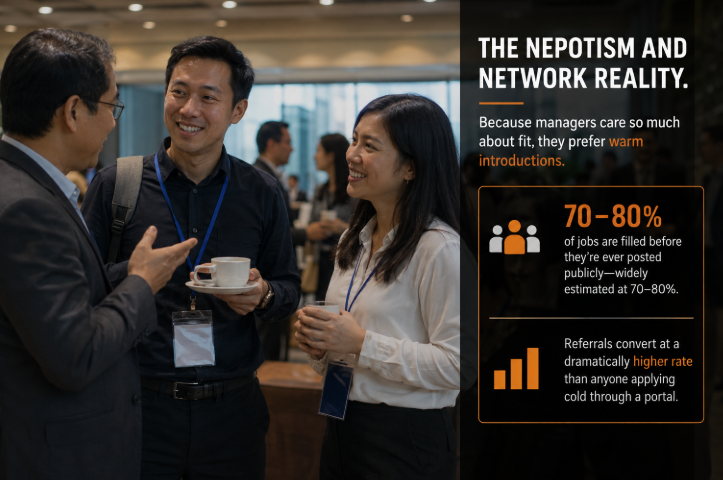
    The nepotism and network reality. Because managers care so much about fit, they prefer warm introductions. A large share of jobs are filled before they’re ever posted publicly, widely estimated at 70 to 80%, leaving standard applicants fighting over scraps. Referral hires convert at a dramatically higher rate than anyone applying cold through a portal.

    The saturation wave. When tech boomed, everyone learned to code, and now entry-level tech is flooded. If everyone stampedes into trades or healthcare next, those gates will tighten too.

    The likability filter. Technical skill is treated as a baseline, not a differentiator. The final decision almost always comes down to human dynamics and team fit.

    How Humans Actually Get Hired Now

    Elite credentials and “wow” experiences are losing their currency. The real strategy is navigating the human element:

    • Target the hidden market. Posting a job online now returns thousands of AI-generated resumes. One large insurer reportedly received 100,000 applications for just 1,400 roles, and recruiters describe jobs pulling over a thousand applicants within minutes of going live. Companies hate their own public hiring process. Landing a job increasingly means bypassing the portal entirely through direct, peer-to-peer networking.
    • Prove fit before the interview. Show you understand the team’s specific culture and pain points before you ever sit down. Research the team dynamic, not just the company name.
    • Go micro-niche. Instead of drowning in massive talent pools, the survivors find hyper-specific micro-industries where the candidate pool is naturally small. Easier to stand out, easier to fit.
    professionals networking, showing how the broken job market really hires

    Yes, it’s an absolute nightmare. No sugarcoat. Just the truth.

    And Governments Are Asleep at the Wheel

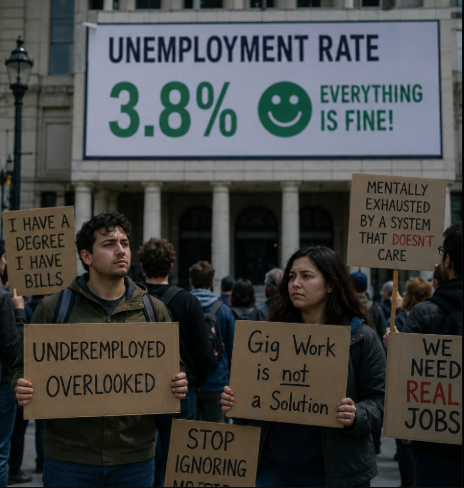
    Here’s what makes it worse: most governments are completely unprepared, using a 20th-century playbook against a 21st-century crisis. They point at low unemployment statistics and declare everything fine, ignoring the underemployment, the gig-economy desperation, and the psychological grind of the modern job hunt.

    The problem is political time. Politicians think in election cycles of four or five years. The structural collapse of the job market is a ten-to-twenty-year problem. Long-term planning is expensive, so governments reach for temporary band-aids instead.

    But if a government actually wanted to face this honestly, a real solution would look like this:

    1. Break the university degree monopoly. Stop funding and glorifying three-to-four-year degrees as the default path to survival. Shift public money toward modular, three-to-six-month technical and behavioral certifications. Stop subsidizing institutions that pump thousands of graduates into fields with zero market demand.

    2. Legislate and regulate AI hiring. We heavily regulate financial markets and physical safety, yet we let algorithmic black boxes decide who gets to eat. Penalize automated screening that rejects candidates on arbitrary keyword matches. Force human-centric, auditable hiring so qualified people aren’t filtered out by a machine before a human ever sees them. The evidence is damning. In one major Harvard Business School study, 88% of employers admitted their own systems screen out qualified candidates, and in the United States alone an estimated 27 million capable “hidden workers” are locked out of the market entirely.

    3. Incentivize micro-businesses and subsidize “fit” apprenticeships. As big corporations shrink their human footprint, make it cheap for small teams to form. Give real tax breaks to companies under 20 people to hire and train for attitude and fit, not just credentials. Subsidize apprentice salaries for the first six months so small businesses can take a chance on someone with the right character but no “wow” resume.

    remote worker outside the city in the broken job market

    4. Implement a UBI or job guarantee. As automation and saturation deepen, there simply won’t be enough traditional 40-hour jobs for the global population. The World Economic Forum projects tens of millions of roles displaced by the end of the decade, even as tens of millions of new ones emerge. Sever the link between basic survival and corporate employment through a baseline income funded by taxing automated corporate productivity. Give people breathing room to fail, retrain, or work part-time without facing immediate homelessness.

    The Real Question

    None of this is impossible. The mechanics are understood. The data is public. The solutions are on the table.

    But the real question about this broken job market isn’t can they fix it. It’s whether they’ll even care to try, for their own people.

    SOURCES:


  • The Machine That Runs on Nothing

    The Machine That Runs on Nothing

    There is a particular kind of lie that does not need to be true to work. It only needs to be repeated by the right people, at the right volume, against the right nerve. Feed it enough repetition and it stops behaving like a claim and starts behaving like a fact, not because anyone proved it, but because everyone around you seems to believe it, and your brain, ancient and social and terrified of being the odd one out, quietly rewrites itself to match the room.

    We like to think we believe things because they are true. We do not. We believe things because they are ours, because our side holds them, because doubting them would cost us the people we belong to. That single crack in human nature is the whole doorway. Give a capable operator that one weakness, add a few hundred coordinated accounts to fake the sound of a crowd, and you can march an entire population into certainty about something that was never real. The substance is optional. The certainty is the product. And the product sells.

    Indonesia has been running a live experiment in this for over a decade, and its cleanest specimen has a name: the diploma.

    The Jokowi diploma hoax did not come from evidence. It came from anonymous accounts in April 2014, in the middle of a presidential campaign, circulating photocopies and pointing at a name spelling and a serial number. By July, leaflets were being handed around Solo and Jakarta days before the vote. The university denied it immediately. That should have been the end of it in 2014.

    Instead, it came back. It returned in 2019 for the next election, against a different opponent, wearing the same clothes. It escalated into a courtroom in October 2022, when the author of Jokowi Undercover filed a civil suit, only to withdraw it after he was arrested on separate hate speech charges. And it rose again after that, until it was finally tested the hard way: dozens of witnesses, forensic laboratory analysis of the documents, university records, classmates, the people who signed them. In 2025 the investigation closed. No forgery. No crime.

    Look at that shape. Not a rumour that flared and died, but one that hibernates and returns on schedule, every time it becomes politically useful. Ten years. Three election cycles. Denied by the university, abandoned in court, and dismantled by a forensic laboratory, and still it walks. That is not doubt. Doubt dies when the evidence arrives. This is something built to survive evidence, because it was never made of evidence in the first place.

    And it did what these things always do. It found people who were already angry and handed their anger a target. That is the thing nobody wants to admit about themselves: the belief came first. The proof was reverse engineered later, assembled backwards from a conclusion people had already decided to feel. A letter in a name. A serial number. The kerning of a font. Ear shapes in a graduation photo. Grown adults turned into amateur forensic examiners overnight, not because they found something, but because they needed the thing they already believed to be findable.

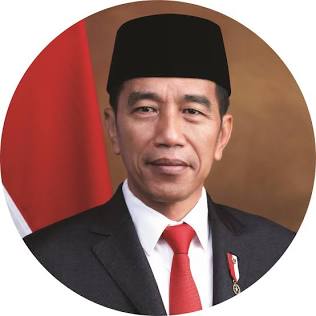
    Jokowi the 7th Indonesia President

    And when the finding of no crime finally landed, it did not land at all. It was absorbed as further proof of the cover up. Watch that move closely, because it is the fingerprint of manufactured belief: every rebuttal becomes evidence of the conspiracy, every calm clarification from the university becomes part of the plan, and the story, refusing to die, quietly relocates to the next allegation. Honest doubt updates when the evidence arrives. Manufactured doubt just moves house.

    And here is where it stops being about a diploma at all.

    Because the same wiring that spreads the lie also makes it cruel. The screen strips the ordinary person of the face they wear in real life, the neighbour, the civil servant, the polite stranger, and hands them a mob to disappear into, where nobody is responsible because everyone is. The target stops being an argument and becomes a hunt. It moves off the document and onto the man, then off the man and onto his children, his family, his circle, because the point was never the diploma. The point was the permission to attack.

    And most of them believe they will never pay for it. This is the quiet lie inside the loud one: that the locked profile, the fake name, the buzzer account, make a person untouchable. It is not true. The cruelty is documented. It is legally actionable. The law that could reach it exists. Yet the worst of it still goes unpunished, not because the law is absent, but because it is outrun, engineered around by people who built their anonymity for exactly this reason. There is a machinery of hiding, and it is as deliberate as the machinery of attack.

    Above all of it sits the part almost no one wants to say out loud, because it implicates something bigger than any buzzer. The platforms see this. They have always seen it. They hold every tool required to slow it, and they choose not to, because the rage is not a malfunction of the system. The rage is the business model. Outrage travels farther, holds attention longer, and sells more than any calm truth ever could, so the machine that destroys a stranger is the same machine that prints the platform’s revenue. It is not that they fail to stop it. It is that they have no reason to.

    If any of this feels familiar, it should. This exact engine has bolted itself onto different faces in different countries, obeying the same physics every time: find a figure who threatens someone’s sense of us, and it stops mattering what that figure actually did. The outrage arrives first and goes looking for its reason afterward. I wrote about a version of this engine wearing an American face. This is the version wearing an Indonesian one. Peel off either mask and the machine underneath is identical, and it is already warming up for whoever is next.

    Now the part almost nobody is willing to sit with.

    The machine does not run on evil. It runs on you. On the most ordinary, most human instincts you own, the need to belong, the pull of the crowd, the exhaustion that makes you scroll instead of check, the quiet relief of letting the group think for you. These are not defects in bad people. They are standard equipment in all of us, and that is exactly why they can be harvested at industrial scale by anyone with the skill and the numbers to do it. You are not safe because you are intelligent. The intelligent are often easier prey, because they are so much better at building sophisticated reasons for what they had already decided to feel.

    So the question worth your attention is not whether the diploma was real. That one is answered, and answered dully, in a closed police file. The question that outlives Jokowi, and Ahok before him, and the name none of us have heard yet, is the one that should make the back of your neck cold:

    Why does a lie with nothing inside it defeat a truth with everything?

    That is the subject. Not one man’s diploma, but the engine beneath it. How it is built. Who profits from turning your outrage into their income. Why your own mind hands it the keys and thanks it afterward. How a disagreement curdles into a hunt, how a hunt becomes a crime, and how a society drowning in manufactured noise slowly stops believing that truth is even worth reaching for. That is what the Jokowi diploma hoax was really built to do.

    I am taking the whole machine apart, piece by piece, and laying the parts on the table with their real names attached.

    This was only the sound of it turning over.

    The full teardown is coming soon, as a mini book, in the AbyssDome Store.

    Sources:

    Kompas – Cerita di Balik SP3 untuk Eggi Sudjana dan Damai Lubis di Kasus Ijazah Palsu Jokowi

    Detik – Polisi Resmi Terbitkan SP3 Rismon Sianipar di Kasus Ijazah Jokowi

    ANTARA – Polda Metro Hentikan Kasus Tiga Tersangka Laporan Ijazah Palsu Jokowi