

You did everything right. The degree, the skills, the polished CV, and still nothing but silence, rejection emails, and application portals that swallow your effort whole. It isn’t you. The rules changed, and nobody updated the playbook. Here’s the raw mechanics of the broken job market, and how hiring actually works now, from someone who spent years on the other side of the desk. → Read the full article
Something has quietly collapsed, and most people are still being told to fix it with a better resume.
The truth is harder than that. The job market isn’t just competitive anymore. It’s structurally broken for both sides. Candidates are trapped in an endless loop of ghosting, rejection letters, and black-hole application portals. Meanwhile, hiring managers are drowning in thousands of AI-padded resumes, desperate to find one reliable person who can actually do the job and get along with the team.
It feels like a high-stakes lottery where the rules change daily, hard work no longer guarantees anything, and the finish line keeps moving. Let me explain why.
The Three Cracks in the Foundation
The skills mismatch. Universities are still preparing students for roles that are being automated. The method of learning has barely changed since the 1600s, and the institution is more obsessed with title and prestige than with real education that actually improves human lives. The result is a surplus of graduates trained for a world that no longer needs them. Across advanced economies the numbers are brutal: in the United States, more than four in ten recent graduates are underemployed, working jobs that don’t require the degree they went into debt for. The International Labour Organization warns that worldwide, progress toward decent work has stalled and young people are being squeezed hardest of all. That is not an accident. It’s the system working exactly as it was built to, just for a world that no longer exists.

The “entry-level” trap. Automated screening software and inflated employer demands have made the first rung of the ladder almost impossible to reach. Job descriptions now routinely ask a 22-year-old to demonstrate the judgment of a 35-year-old. Analysts are calling it “seniorization.” You need the job to get the job. It’s an artificial bottleneck, and it’s crushing an entire generation.
The content gap. The highly visible fields everyone chases, corporate tech and media, are oversaturated, while massive, high-paying sectors quietly starve for workers. And nobody in academia is criticizing this hard enough. The gap between the number of people on this earth and the number of meaningful jobs available isn’t close. It’s a canyon.
Where the Real Jobs Actually Are
The work that survives is the work a machine can’t download:
- High-touch human empathy. Healthcare, therapy, mental health support, specialized teaching.
- The physical and skilled trades. Electrical, plumbing, green-energy installation, advanced manufacturing. You cannot download a physical repair. And the shortage is global: in 2026, roughly 72% of employers worldwide said they couldn’t find the skilled workers they need, close to a record high, with skilled trades and engineering among the hardest roles of all to fill.
- Complex problem-solving. Systems engineering, cybersecurity, data ethics, and directing AI tools rather than being replaced by them.
- The creative-strategic blend. High-level negotiation, crisis management, hyper-local community building
The Playbook Everyone Gives You Is Dead
“Get a degree, get a job” is over. The advice that still works looks different:
- Become a polymath. Combine two unrelated skills, coding plus agriculture, or design plus psychology, and you drastically cut your competition.
- Prioritize durable skills. Adaptability, communication, emotional intelligence. These never expire.
- Build a public portfolio. Show what you can do, not just what you studied. Side projects and public creation prove value faster than any resume.
- Look outside the capitals. Remote work and regional development mean the best opportunities are increasingly outside the oversaturated mega-cities.
And yet, imagine having all these skills and still getting nothing. Because here’s the part the LinkedIn gurus won’t tell you.
The Reality of the Broken Job Market
From my years in management and human resources, I’ll give you the raw truth: on paper, qualifications get you through the door, but “culture fit” and chemistry are what actually land the job. The best resume in the world means nothing if the manager thinks, “I don’t want to sit in a room with this person for eight hours a day.”
Tragic, isn’t it? Let’s look at this bottleneck through the HR lens:
The nepotism and network reality. Because managers care so much about fit, they prefer warm introductions. A large share of jobs are filled before they’re ever posted publicly, widely estimated at 70 to 80%, leaving standard applicants fighting over scraps. Referral hires convert at a dramatically higher rate than anyone applying cold through a portal.
The saturation wave. When tech boomed, everyone learned to code, and now entry-level tech is flooded. If everyone stampedes into trades or healthcare next, those gates will tighten too.
The likability filter. Technical skill is treated as a baseline, not a differentiator. The final decision almost always comes down to human dynamics and team fit.
How Humans Actually Get Hired Now
Elite credentials and “wow” experiences are losing their currency. The real strategy is navigating the human element:
- Target the hidden market. Posting a job online now returns thousands of AI-generated resumes. One large insurer reportedly received 100,000 applications for just 1,400 roles, and recruiters describe jobs pulling over a thousand applicants within minutes of going live. Companies hate their own public hiring process. Landing a job increasingly means bypassing the portal entirely through direct, peer-to-peer networking.
- Prove fit before the interview. Show you understand the team’s specific culture and pain points before you ever sit down. Research the team dynamic, not just the company name.
- Go micro-niche. Instead of drowning in massive talent pools, the survivors find hyper-specific micro-industries where the candidate pool is naturally small. Easier to stand out, easier to fit.

Yes, it’s an absolute nightmare. No sugarcoat. Just the truth.
And Governments Are Asleep at the Wheel
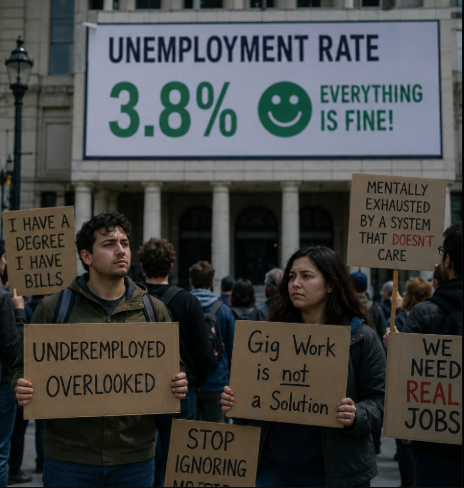
Here’s what makes it worse: most governments are completely unprepared, using a 20th-century playbook against a 21st-century crisis. They point at low unemployment statistics and declare everything fine, ignoring the underemployment, the gig-economy desperation, and the psychological grind of the modern job hunt.
The problem is political time. Politicians think in election cycles of four or five years. The structural collapse of the job market is a ten-to-twenty-year problem. Long-term planning is expensive, so governments reach for temporary band-aids instead.
But if a government actually wanted to face this honestly, a real solution would look like this:
1. Break the university degree monopoly. Stop funding and glorifying three-to-four-year degrees as the default path to survival. Shift public money toward modular, three-to-six-month technical and behavioral certifications. Stop subsidizing institutions that pump thousands of graduates into fields with zero market demand.
2. Legislate and regulate AI hiring. We heavily regulate financial markets and physical safety, yet we let algorithmic black boxes decide who gets to eat. Penalize automated screening that rejects candidates on arbitrary keyword matches. Force human-centric, auditable hiring so qualified people aren’t filtered out by a machine before a human ever sees them. The evidence is damning. In one major Harvard Business School study, 88% of employers admitted their own systems screen out qualified candidates, and in the United States alone an estimated 27 million capable “hidden workers” are locked out of the market entirely.
3. Incentivize micro-businesses and subsidize “fit” apprenticeships. As big corporations shrink their human footprint, make it cheap for small teams to form. Give real tax breaks to companies under 20 people to hire and train for attitude and fit, not just credentials. Subsidize apprentice salaries for the first six months so small businesses can take a chance on someone with the right character but no “wow” resume.

4. Implement a UBI or job guarantee. As automation and saturation deepen, there simply won’t be enough traditional 40-hour jobs for the global population. The World Economic Forum projects tens of millions of roles displaced by the end of the decade, even as tens of millions of new ones emerge. Sever the link between basic survival and corporate employment through a baseline income funded by taxing automated corporate productivity. Give people breathing room to fail, retrain, or work part-time without facing immediate homelessness.
The Real Question
None of this is impossible. The mechanics are understood. The data is public. The solutions are on the table.
But the real question about this broken job market isn’t can they fix it. It’s whether they’ll even care to try, for their own people.
SOURCES:
- Harvard Business School & Accenture, Hidden Workers: Untapped Talent (the 88% figure and the 27 million hidden workers in the US)
- ManpowerGroup, 2026 Global Talent Shortage Survey (72% of employers worldwide struggle to fill roles; skilled trades and engineering hardest)
- International Labour Organization / UN News, global employment stable but decent jobs in short supply (stalled progress on decent work; young people squeezed; AI risk)
- Fortune, PwC’s “seniorization” of entry-level work (US recent-grad underemployment at 42.5%, and the vanishing first rung)
- From Day One, how AI-generated resumes are flooding recruiters (100,000 applications for 1,400 roles; jobs pulling a thousand applicants in minutes)
- Great Resumes Fast, the hidden job market and referral hiring data (the 70 to 80% estimate and referral conversion rates)
- World Economic Forum, Future of Jobs Report 2025 summary (tens of millions of roles displaced and created through 2030)
Leave a Reply