
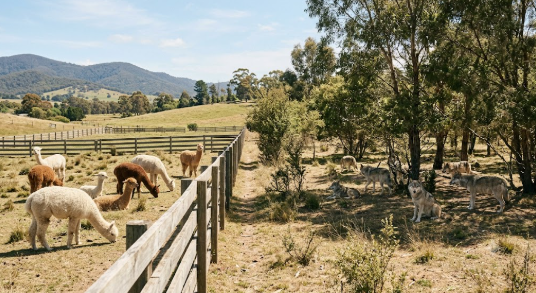
Nuanu Creative City, located in Tabanan, has brought in non-native animals for commercial visitor attractions, most notably alpacas, the primary non-native species brought into Nuanu. They are housed at Pacha Alpaca, also promoted as the Alpaca Lodge or Alpaca Park, an interactive attraction where visitors pay admission to pet, feed, and walk with them.
Nearby, at Alpha Wolf Lodge, the same model operates on a larger animal. Visitors pay entry fees to interact with the pack. The venue offers ticketed experiences such as wolf yoga, beach walks along Nyanyi Beach, photoshoots, film and commercial rentals, and private villa stays where guests sleep adjacent to the wolf enclosures. Wolves and wolf hybrids are naturally adapted to cold, northern climates. While the owners claim the animals adapt to Bali by shedding coat layers and spending time in air-conditioned rooms or pools, housing wild-canine hybrids in a hot, tropical climate for commercial entertainment raises significant welfare concerns.
Much like the imported alpacas, the wolf lodge relies on novelty to attract high-paying tourists. Large sums of money and marketing are poured into promoting exotic foreign canines for Instagram photos, while indigenous Bali Heritage Dogs, the island’s native, genetically rich canines, continue to suffer from neglect, displacement, and abuse right outside the compound’s gates.
None of this stems from any shortage of animals of Indonesia’s own. Indonesia is one of the most biodiverse countries on Earth. It is world-renowned for native species such as Komodo dragons, orangutans, Sumatran tigers, tarsiers, and the Bali starling (Jalak Bali). There is no shortage of unique, iconic animals here.
Crucially in Bali, the Bali Heritage Dog (Anjing Trah Bali) represents an ancient, genetically distinct breed that has lived alongside local communities for thousands of years. Research published in BMC Genetics found the Bali street dog to be the most heterogeneous group tested, carrying 239 of the 366 alleles observed across all breeds and populations examined, thirteen of which appeared in no other group. The authors concluded that a viable and diverse dog population existed on Bali before the island’s geographic isolation approximately 12,000 years ago, and has been little influenced by domesticated European dogs since.
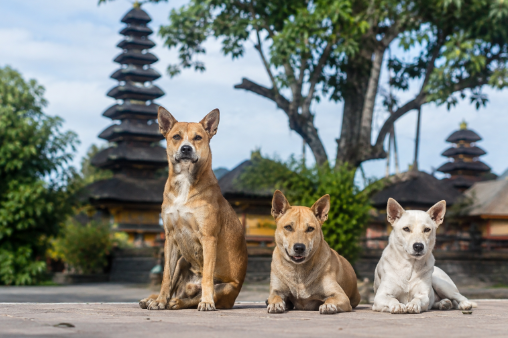
Against that, importing South American alpacas is a commercial tourist gimmick designed for novel social media appeal. It creates a stark, painful contrast. Significant capital and attention are poured into showcasing foreign animals for profit, while native Balinese heritage dogs on the street, who carry deep ecological and cultural history, continue to face neglect, mistreatment, and a struggle for survival.
The Exotic Novelty Syndrome: Performative Empathy in a Digital Age
Behind that contrast sits a striking psychological glitch in modern human behaviour. The closer something is to our daily reality, the easier it becomes to ignore. Conversely, the more foreign, artificial, or out of place an object is, the more value we project onto it.
This cognitive flaw thrives within commercialised, aesthetic-driven spaces.
- Instagram-driven compassion. Visitors willingly purchase high-priced admission tickets, queue up for curated photo opportunities, and express deep affection for imported cold-climate animals like wolves and alpacas. The engagement is superficial, driven by social media status and the appeal of the unusual.
- Tropical dissonance. To maintain this illusion, northern-latitude animals are placed into humid tropical environments and kept comfortable through air-conditioned rooms and artificial setups, all to serve as backdrop props.
- Selective empathy. The very same individual who pays to feed an imported animal will walk straight past a starving, dehydrated dog suffering on the street outside the venue gates. When compassion requires a ticket, it ceases to be true empathy. It becomes a consumer experience.
The Erasure of Ancient Heritage: What the Bali Heritage Dog Lost
That selective empathy has a cost, and the Bali Heritage Dog pays it. Bali is home to one of the world’s oldest and most genetically unique canine lineages. For thousands of years, these dogs have lived alongside the island’s ecosystem and communities, carrying an unbroken biological link to early indigenous canines.

Yet commercial expansion has rewritten their narrative through a harmful inversion of value.
From sacred heritage to nuisance. An ancient, indigenous dog with thousands of years of local history is frequently dismissed, displaced, or left to fight for survival on the roadside.
Meanwhile, imported farm animals and northern predators are elevated to luxury attractions, rebranded as exotic wonder, and marketed as high-end entertainment.
Cultural amnesia. When a society begins prioritising imported novelties over its own indigenous ecosystem, it suffers a form of cultural amnesia. True richness lies in preserving native biodiversity, not in manufacturing a pseudo-exotic playground for tourists.
Capitalist Sanctuaries Versus Ground-Level Reality
The language used to sell these places deserves the same scrutiny. In the lexicon of modern commercial developments, words like sanctuary, lodge, and eco-park are often heavily weaponised. They function as marketing tools designed to sanitise what is, at its core, a profit-driven interactive exhibit.
The stark financial contrast between corporate attractions and authentic ground-level welfare reveals a painful truth.
Capital versus grit. Millions of dollars flow into building air-conditioned enclosures, importing animals, and running slick marketing campaigns. In sharp contrast, actual animal welfare, the daily feeding, medical treatment, sterilisation, and rescue of native animals, is left to grassroots individuals working with minimal resources and sheer willpower.
Commercial profit versus community burden. Corporate ventures extract commercial profit from animal exhibits without taking responsibility for the surrounding animal welfare crisis. They sell a sanitised vision of nature while the burden of real care falls entirely on local rescuers.

The co-opted buzzword. Calling a ticketed tourist facility a sanctuary distorts the definition of true refuge. A genuine sanctuary provides protection from exploitation. It does not charge admission fees for photo ops and interactive walks.
The Systemic and Legal Loophole: Permits Over Protection
Behind every commercial spectacle lies a regulatory framework, and that framework reveals a government’s true priorities. When exotic, non-native species cross borders to become photo props, it exposes a glaring double standard in how laws choose to value life.
The structural contrast between corporate ease and native neglect is stark.
Commercial greenlights versus public health neglect. Corporate entities navigate agricultural and quarantine protocols with ease to secure import permits for foreign profit-makers. The pattern holds even under scrutiny. When Commission I of the Bali Provincial DPRD conducted a snap inspection at Pantai Nyanyi in Beraban, Tabanan, in August 2025, raising incomplete permits, use of land classified as protected agricultural land, minimal contribution to the region, and damaged road access, operations continued unaffected. Meanwhile, basic systemic funding for native rabies management, humane spay and neuter campaigns, and population control remains chronically underfunded and dependent on private charity.
Selective accountability. Regulatory frameworks grant licences to private developers allowing them to house foreign animals, yet hold those same developments completely blameless for the surrounding local animal crisis. A developer can build a luxury compound atop displaced wildlife while ignoring the starving native dogs on its perimeter.

Capitalising on loophole ethics. Laws exist to govern agricultural transport and disease transmission, but rarely to evaluate the psychological and ecological ethics of keeping cold-climate species in tropical microclimates. So long as the paperwork clears, commercial interest overrides animal welfare.
The Closing Reality Check: Stripping Away the Illusion
If we are to talk about harmony with nature, we must first strip away the high-priced marketing, the curated hashtags, and the performative sanctuaries. True stewardship does not exist behind a turnstile, nor does it carry an admission fee.
To break through the exotic illusion, a fundamental shift in perception must take place.
- Demanding genuine stewardship. Consumers and tourists must look past the glitz of ticketed interactive experiences and ask uncomfortable questions. When an attraction relies on imported novelty while ignoring indigenous suffering, it is not an eco-sanctuary. It is an exploitation model.
- Reclaiming the Bali Heritage Dog. The Bali Heritage Dog is not a stray nuisance to be cleared away for tourist resorts. It is a genetically priceless treasure woven into the island’s ancient history. Recognising their value is a matter of ecological pride and cultural preservation.
- Honouring real guardianship. True rescue work happens in the mud, in the heat, and on the streets, through silent, daily action. Feeding, treating, and protecting lives without expecting applause or profit. It is time to stop funding manufactured illusions and start backing the genuine guardians fighting for Bali’s living legacy.
Some of these dogs are ready for homes right now. You can meet them at Adopt.
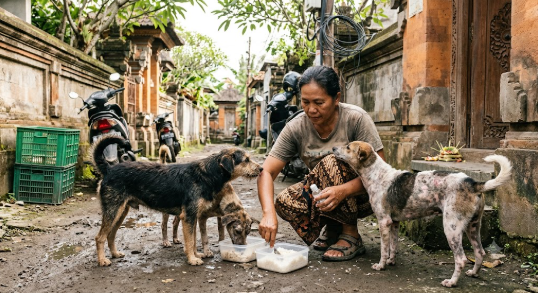
The dogs outside those gates are not waiting for a rebrand. They are waiting to be fed, treated, and loved with the same devotion lavished on the imported animals inside. They were here first, and they are still waiting.
Sources
- Peer-reviewed genetic analysis establishing the Bali street dog as the most heterogeneous population tested, published in BMC Genetics: Genetic variation analysis of the Bali street dog using microsatellites
- detikBali report on the DPRD Commission I inspection at Pantai Nyanyi and the company’s response: Nuanu Klarifikasi Hasil Sidak Komisi I DPRD Bali detik
- Radar Badung on central government approvals, land lease status, and building permits: Setelah Disidak DPRD Bali, Manajemen Nuanu Creative City Sebut dapat Izin dari Pemerintah Pusat
- National framework governing quarantine protocols, health certification, and import permits for non-native live animals: UU No. 21 Tahun 2019 tentang Karantina Hewan, Ikan, dan Tumbuhan
- JAAN Indonesia on commercial animal attractions and wildlife kept in artificial conditions for entertainment: The Future of Tourism and Wildlife in Bali
- World Animal Protection on commercial venues in Bali and welfare standards: Bali Report
- Grassroots street dog rescue and sterilisation funded entirely by volunteers and private donation: Bali Street Dog Fund
- Native dog sterilisation efforts operating without corporate or government funding: We Do OCEAN
- Nuanu Creative City official site: nuanu.com
- Pacha Alpaca official site: pacha-alpaca.com
- Alpha Wolf Lodge official site: alphawolflodge.com
- Alpha Wolf Lodge ticketed experiences and packages: Megatix Indonesia listing
Leave a Reply