
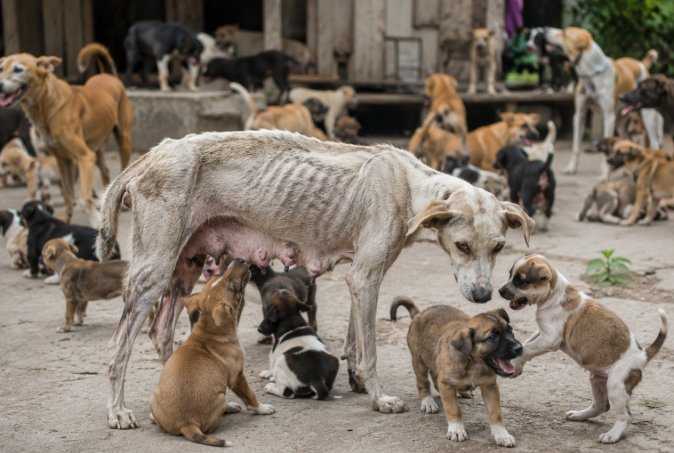
Bali dog sterilisation is the only intervention that stops this problem at its source, and the numbers below are why.
A healthy female dog can physically produce anywhere from 2 to 24+ puppies per year, depending primarily on her breed size, overall health, and age. On average across all breeds, a female dog produces about 10 to 12 puppies per year if she carries two litters.
Reproductive frequency: most intact female dogs go into heat twice per year (every 6 to 8 months), though smaller breeds can cycle up to three times annually and giant breeds may cycle only once every 12 to 18 months. Canine gestation lasts roughly 63 days, about two months, allowing enough time biologically to carry 1 to 2 litters per calendar year.
Small and toy breeds (Chihuahuas, Pomeranians, French Bulldogs) produce 1 to 4 puppies per litter, a theoretical annual yield of 2 to 8 puppies. Medium breeds (Beagles, Cocker Spaniels, Poodles) produce 5 to 7 puppies per litter, a theoretical annual yield of 10 to 14 puppies. Large and giant breeds (Labradors, German Shepherds, Mastiffs) produce 8 to 12+ puppies per litter, a theoretical annual yield of 16 to 24+ puppies.
THIS IS FOR 1 SINGLE DOG………….
Now hold that single dog in your mind and widen the frame. Imagine Bali, with a dog population of roughly 700,000 and very little sterilisation reaching it. Many of those dogs have no access to sterilisation at all. No large organisation and no well funded sterilisation centre reaches the secluded areas. Singaraja is one example.

That figure is not guesswork, and it is not inflated. Bali’s Dinas Pertanian dan Ketahanan Pangan recorded an official dog population of 565,737 in 2025: Badung 95,000, Denpasar 82,545, Karangasem 78,975, Gianyar 78,266, Buleleng 70,298, Tabanan 54,726, Bangli 46,707, Jembrana 41,668, Klungkung 17,552. But in July 2025, after population trials conducted with the World Organisation for Animal Health, the Ministry of Agriculture through BBV Denpasar stated that the real population is larger than the official estimate and that the counting method would have to be revised. The government has said, on its own record, that its own number is too low.
That admission carries further than it looks. Reported rabies vaccination coverage for 2025 was 85.35 per cent, or 482,868 dogs, but that percentage is calculated against a denominator the government itself has already disowned. Measured against a population nearer 700,000, the same 482,868 dogs represent roughly 69 per cent. And the average conceals where the shortfall sits: Karangasem reached 96.25 per cent, while Buleleng, the regency containing Singaraja, vaccinated 51,885 of 70,298 dogs, roughly 74 per cent. Sixteen people died of rabies in Bali in 2025, out of 66,760 recorded bites.
Yearly data and numbers may change, following developments we cannot predict. But the fact remains that a single female dog can have 70 to 90 pups in her lifetime, more in the large breeds, and her pups will have more. These are the points I want to raise, and what I want people to be aware of.
The peak of fertility in dogs occurs between 2 and 5 years of age. A female dog’s first litter is typically smaller than average, and litter sizes steadily decline after age 5 or 6 as fertility decreases and reproductive risks rise. But female dogs can still get pregnant and give birth outside that 2 to 5 year peak window, both before they turn 2 and long after they turn 5.
Unlike humans, female dogs do not go through menopause. An intact female dog remains biologically capable of coming into heat and conceiving throughout her entire life, right into her senior years, unless she is STERILISED (SPAYED).

In older dogs, age 6 and above, fertility naturally declines, often resulting in smaller litters or a higher likelihood of unfertilised eggs, but she can still become pregnant. However, pregnancy in senior dogs carries severe health risks. Older females face a dramatically higher risk of life threatening uterine infections like pyometra, labour complications (dystocia), high maternal mortality, and severe physical exhaustion from nursing.
At the other end of her life the danger is just as sharp. Young dogs under 2 years can get pregnant during their very first heat cycle, which often occurs between 6 and 12 months of age depending on the breed. Because her skeleton and organs are not yet fully grown, carrying a litter this early poses serious risks of birth complications, and young mothers often struggle with maternal instincts or physical milk production.
Between those two points, there is no safe pause. Because an older female’s body continues to cycle every 6 to 8 months regardless of age, the biological drive and capacity to reproduce never naturally stop. Without Bali dog sterilisation reaching her, a senior female remains constantly vulnerable to accidental pregnancies that her ageing body cannot easily handle.
Veterinary and health reality: while a dog can physically bear litters back to back during consecutive heat cycles, doing so severely depletes her physical reserves and increases the risk of uterine infections, malnutrition, and birth complications.
On average, a female dog will produce between 15 to 30 puppies in her lifetime under managed, responsible conditions. However, if an unspayed female dog breeds continuously throughout her entire life without intervention, she can physically give birth to 70 to 90 puppies over her lifespan, and considerably more in the largest breeds.

The uncontrolled biological maximum sits higher still. An intact female dog cycles about twice a year from age 1 through her senior years, ages 9 to 11+. If she conceives during every heat cycle over a decade, she can produce 15 to 20 litters. Across her entire lifespan, an unspayed female can directly give birth to between 70 and 90 puppies.
Small breeds (Chihuahuas, Pomeranians): 10 to 25 puppies lifetime maximum, due to smaller litters of 1 to 4 pups. Medium breeds (Beagles, Spaniels): 35 to 60 puppies lifetime maximum, at 5 to 7 pups per litter. Large and giant breeds (Labradors, Mastiffs): 70 to 120+ puppies lifetime maximum, due to large litters of 8 to 12+ pups.
The exponential descendant impact is the part people miss. One female dog directly bears several dozen puppies herself, but her actual population impact expands exponentially. If her puppies and their offspring are also left unspayed and unneutered, a single female and her immediate line can contribute to thousands of stray or homeless dogs in just 4 to 6 generations. Mass culling in Bali will continue. There are not enough rescuers to save them, and the bottom line is that these dogs always bear the pain.
And culling has already been tested here, at scale, with a documented result. Between 2008 and 2011, approximately 108,000 dogs were killed in Bali in response to rabies. Peer reviewed analysis published in PLOS One found that culling did not reduce rabies cases and did not prevent the disease from spreading across the island. The dogs died. The problem did not.
One intervention actually works, and one choice about who it is performed on
Sterilise a male, and another male replaces him within days. The females around him remain intact and nothing changes. Sterilise one female, and every number above this line becomes zero: the two litters a year, the 70 to 90 across her lifetime, the thousands across four to six generations. Female surgery costs more and takes longer to recover from, which is exactly why underfunded programmes do males instead, and exactly why the population never falls.
What Bali dog sterilisation actually costs
In Singaraja, working with a local vet, Bali dog sterilisation costs 500,000 rupiah per dog, and a trip only runs with a minimum of around ten dogs. Other areas may cost more.
That minimum is the part almost nobody sees. This work is not funded per dog; it is funded per trip. I cannot drive to Singaraja for one female. The smallest action that is physically possible costs 5,000,000 rupiah, and below that threshold nothing moves at all. Ten females sterilised removes somewhere between 80 and 120 puppies from the street every year, for the rest of their lives.
Why that money does not arrive
Donors fund what they can see. Places with tourists produce photographs, photographs produce posts, posts produce donations. Places without tourists produce none of that, so the dogs there go unfunded, not because the need is smaller but because nobody is looking. Requests for Bali dog sterilisation reach me from everywhere, Singaraja and Denpasar and everywhere between. That is not a shortage of need. It is a shortage of anyone going.

What I can carry and what I cannot
I have paid for some of this myself, and much of it I have carried without anyone knowing. Every sterilisation, every course of medication, every trip, out of my own pocket, alongside everything else I am responsible for.
If you fund a dog, you will see that dog…..
What I cannot do is carry it indefinitely alone. Every rupiah is one female who will never produce another litter. Every ten is one trip that becomes possible.
Fund one female for Bali dog sterilisation. That is the whole request.
[DONATE – AbyssPaws]
Each round added here by date, location, number of dogs, and cost.
Sources
- Dinas Pertanian dan Ketahanan Pangan Bali on the 2025 dog population of 565,737 and rabies vaccination coverage of 85.35 per cent.
- Dog population and vaccination figures broken down by regency.
- The Ministry of Agriculture and BBV Denpasar on population trials with WOAH indicating Bali’s dog population is larger than the official estimate.
- Peer-reviewed analysis in PLOS One recording approximately 108,000 dogs culled in Bali between 2008 and 2011 without reducing rabies cases or preventing its spread.
- Dinas Pertanian dan Ketahanan Pangan Provinsi Bali on rabies control strategy, including population control.
Leave a Reply