Tag: rabies

  • Bali’s Rabies Laws vs. Reality: What the Law Says vs. What Actually Happens

    Bali’s Rabies Laws vs. Reality: What the Law Says vs. What Actually Happens

    Bali rabies laws make the government legally responsible for controlling rabies and administering mass vaccinations. However, under Indonesian law, rabies control is structured as a shared responsibility between the government (providing public health systems, surveillance, and free mass vaccines) and individual animal owners (ensuring their animals are vaccinated, restrained, and not abandoned).

    What does this exactly mean?

    Indonesian law treats rabies control as a dual-track obligation: the government builds and maintains the public health defence system, while individual pet owners must maintain control over their domestic animals.

    So, to be precise: The Government’s Role is Macro Management. First comes Vaccine Provision and Infrastructure, supplying free anti-rabies vaccines for animals (VAR-HPR) and human post-exposure prophylaxis (VAR/SAR for bite victims at Rabies Centres). Then comes Epidemiological Surveillance, where they track bite cases, map red-zone areas, test brain samples of suspected animals, and declare emergency zones. And the last is Mass Campaigns, where they organise island-wide vaccination drives, fund field veterinary teams, and establish village alert networks (TISIRA).

    That last one deserves its own explanation. TISIRA (Tim Siaga Rabies), Rabies Alert Team is an official, village-level task force created by decree (SK Perbekel) to decentralise rabies control right down to the neighbourhood level. Instead of waiting for provincial teams from Denpasar to handle local problems, TISIRA acts as the local frontline defence in every village (Desa).

    A local TISIRA team typically consists of the Village Head (Perbekel) and Banjar Chiefs (Kelihan Banjar), Customary Village Leaders (Desa Adat), local health cadres (Kader Kesehatan) and volunteers. Also, community police and military officers (Bhabinkamtibmas and Babinsa).

    So What TISIRA Actually Does on the Ground starts with Dog Census and Mapping, where the members go door-to-door in their own banjars to count the total number of dogs (both owned and stray) so veterinary services know exactly how many vaccine doses are required.

    Next comes Guiding and Assisting Vet Teams. When government vaccinators arrive, TISIRA members act as local guides. They know where stray packs hang out, who owns which dog, and help catch or hold nervous animals.

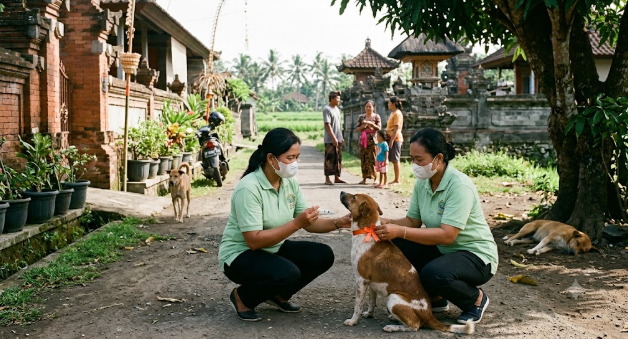
    Bali rabies laws vaccination team in a village

    Then they serve as First Responders for Animal Bites. If a resident gets bitten, TISIRA immediately directs the victim to the nearest Rabies Centre (Puskesmas) for human shots, while simultaneously locating and isolating the biting dog for a mandatory 14-day observation period.

    Lastly, Enforcing Village Customary Rules (Awig-Awig / Parerem), where TISIRA works alongside traditional customary leaders (Desa Adat) to enforce local rules. They issue warnings or customary fines to residents who dump unwanted puppies or allow unimmunised dogs to roam freely in public spaces.

    Now we start to have an interesting conversation here… The government is responsible for a “Vaccination Campaign” (Kampanye Vaksinasi), which is an operational term for a massive, coordinated field action. It means “boots-on-the-ground” medical intervention.

    So when the government executes a mass rabies drive in Bali, they are performing direct, practical actions. They go Direct Door-to-Door Injections (Jemput Bola), where teams of government veterinarians and animal health technicians physically walk through neighbourhoods, entering home yards and searching street alleys to inject dogs and cats directly. Behind that sits Free Vaccine Supply and Logistics, where the government purchases, stores in cold-chain refrigeration, and distributes hundreds of thousands of animal rabies vaccine doses (VAR-HPR) every year, along with syringes, gloves, and restraint tools.

    They also set up Temporary Banjar Clinics, where government vet teams place temporary posts at local Banjar (community) halls on designated days, inviting residents to bring their animals for free shots and immediate health checkups.

    Then the vaccinated dogs are tagged with coloured collars or plastic ribbons so field teams know which animals are protected, and each vaccination is recorded into iSiKHNAS (Indonesia’s Integrated National Animal Health Information System). For the ones the teams cannot reach, they bait street dogs with oral vaccines. For skittish, feral, or unowned stray dogs that run away from nets, government teams distribute Oral Rabies Vaccines (ORV) hidden inside edible baits dropped in areas where stray packs gather.

    I am calling out the elephant in the room now.

    There is a massive chasm between government policy written on paper and the reality on the ground in Bali.

    What was outlined previously represents the official regulatory framework and government press releases. On the street, anyone working in animal rescue or ground-level welfare knows the daily execution tells a completely different story. This I personally fathom and acknowledge. NOW… let us peel it layer per layer.

    1. TISIRA, Censuses, and Village Enforcement: Paper vs. Reality

    Is the Dog Census Happening?

    Bali rabies laws require dog censuses, a field officer recording dogs at a village home

    On Paper: The government claims over 400 village-level TISIRA teams perform dog counting. But the Ground Reality is that systematic door-to-door dog censuses almost never happen in practice. Government population data relies mostly on rough, outdated estimates. This is precisely why veterinary teams routinely run out of vaccine doses midway through a village or vastly miscalculate required supplies.

    Do TISIRA Teams Have Offices? To be surprised, well… I am not surprised, like, at all. No. TISIRA is not a formal institution with a physical office or dedicated staff. It is simply an ad-hoc title given to existing village cadres, Kelihan Banjar (hamlet heads), and local volunteers.

    So, if a resident is bitten, there is no “TISIRA Office” to visit. Victims go straight to a local Puskesmas or hospital, or rely entirely on independent local rescuers for help. In most banjars, residents have no idea who their designated TISIRA members are; or if the team exists at all beyond a signed piece of paper. IF… IF the paper ever existed.

    Which brings me to Mass Culling vs. 14-Day Observation.

    Well, On Paper, official guidelines state that biting dogs should be quarantined and observed for 14 days. BUT, and AGAIN, the Ground Reality is that the default reaction by local authorities (Distanpangan / animal control) during a rabies panic is mass culling (eliminasi). Field officers frequently use strychnine poison or blowdarts to sweep and kill healthy, community-fed, and even vaccinated dogs in the surrounding area rather than setting up proper quarantine or testing.

    And regarding Awig-Awig and Fines for Dumping… the tragedy and where it all started, the Ground Reality is that fining people for dumping unwanted litters is virtually non-existent in 95%+ of Bali villages. While a handful of pilot villages drafted customary rules (Awig-Awig) under foreign NGO guidance, daily enforcement does not happen. Puppies are dumped at markets, rivers, and garbage dumps daily with complete impunity.

    Up to this point, the government deliberately breaches the regulation without any consequences, issues a different and cruel so-called solution, mass culling, and keeps blaming the dogs and the rescuers without any remorse, projecting their incompetencies onto those who actually do the unpaid work for them.

    Then comes the question, How Often Do Mass Rabies Drives Actually Happen? Well, the Official Claim is “annual mass vaccination drives.” And AGAIN (just count how many AGAINs since the beginning of my article), the Ground Reality is that execution is sporadic, reactive, and underfunded. A banjar might see a government vaccination team once, only for officers to disappear for two or three years until a human rabies death makes the news in that regency. Long-term, consistent door-to-door coverage is rarely maintained, leaving massive immunity gaps across districts.

    You have read about iSiKHNAS above, so what is that, and Can You Access It? This is even my million dollar question.

    Village officials discussing rabies control in a Bali banjar

    What is it? iSiKHNAS (Sistem Informasi Kesehatan Hewan Nasional) is an internal, web-and-SMS-based national reporting database used by the Ministry of Agriculture to track livestock and animal diseases across Indonesia. As for Accessibility, it is private, and you cannot access it as a citizen or rescuer. It is a closed government portal, strictly restricted to registered government veterinary officers and livestock personnel.

    So of course, there is no Real Impact on the Ground, and virtually zero visibility for rescuers or the public. It functions primarily as an internal bureaucratic tool so local officials can log data and send reports upstairs to Jakarta. It does not provide real-time public tracking, nor does it fix vaccine shortages or prevent indiscriminate culling on the street. Personally I am amazed by the government effort that has actually done the minimum for a massive and huge ongoing situation in Bali.

    You certainly also read my writing in previous lines about Oral Rabies Vaccines (ORV) and The Sterilisation Failure, so let me finish that thought. The ORV Reality is that it is NOT an active island-wide programme. The deployment of Oral Rabies Vaccine baits in Bali was merely a temporary, small-scale pilot project (conducted around 2021 to 2022 in select trial zones in Buleleng and Karangasem by the FAO and international partners). It is not currently deployed at scale across Bali streets.

    On top of that sits The Tracking Problem. During trial runs, placebos contained temporary blue dye that stained the dog’s mouth briefly to verify ingestion. There is no permanent physical tag, collar, or ear-notch applied to feral dogs eating ORV baits in the wild. Premature execution, premature temporary results, and wasted.

    All of which leads to The Missing Link: Mass Sterilisation (CNVR), the programme that I personally support and urge. Because vaccination without high-volume sterilisation is a losing battle. Please read my article about Catch-Neuter-Vaccinate-Return , because the government spends almost no budget on Catch-Neuter-Vaccinate-Release (CNVR), and unsterilised street and community dogs reproduce rapidly. Within 6 to 12 months, a freshly vaccinated population is outnumbered by new, unvaccinated litters. The heavy lifting of population control in Bali falls almost entirely on private animal shelters, independent rescuers, and charity-funded spay/neuter clinics, not government infrastructure.

    This is the time the government understood and applied their own laws and regulations before pushing them onto its citizens. It is not about the unfairness, simply about the moral standard as human beings together as a population living in Bali.

    Which is why the Governing Laws and Legal Wording matter here, because several national and provincial regulations explicitly lay out government mandates and public obligations regarding rabies in Bali:

    Field team distributing oral rabies vaccine baits to stray dogs in Bali

    National Level: UU No. 18 / 2009 jo. UU No. 41 / 2014

    Under the Law on Livestock and Animal Health (UU Peternakan dan Kesehatan Hewan), rabies is designated as a Penyakit Hewan Menular Strategis (Strategic Infectious Animal Disease / Zoonosis).

    Their own Government Mandate in Articles 42 through 44 states that the Central Government and Regional Governments are obligated to execute prevention, control, and eradication measures for strategic animal diseases. This includes providing vaccines, establishing emergency response protocols, and carrying out surveillance.

    Regional Level: Peraturan Daerah (Perda) Provinsi Bali No. 15 Tahun 2009

    This is the primary legal foundation specifically governing rabies control across all regencies in Bali. Pasal 4 and 5 (Scope) mandate that rabies control is carried out by the Bali Provincial and Regency Governments through systematic prevention, control, eradication, and surveillance.

    Then Pasal 6 (Vaccination) mandates PERIODIC mass vaccinations of Rabies Transmitting Animals (HPR) organised directly by the Government.

    WHILE Pasal 7 and 16 (Owner Obligations) require pet owners to vaccinate their animals annually, maintain proper care, prevent animals from roaming freely in public spaces without leashes, and report any bite incidents.

    Alongside that sits Regional Level: Perda Provinsi Bali No. 5 Tahun 2023, Pasal 28, which prohibits abandoning pets, letting animals roam unattended in public areas, abusing animals, and trading or circulating dog meat.

    AGAIN, yes… AGAIN, those regulations without implementation and minimum execution.

    NOW…

    The Owner’s Legal Duties sit at the Micro Management level, where under Perda Bali No. 15 / 2009 and Perda Bali No. 5 / 2023 (Pasal 28), owning an animal carries strict legal obligations:

    • Confinement (Pengandangan / Perantaian): Owners are strictly prohibited from letting their dogs roam freely in public spaces without supervision or a leash. Please read and understand the meaning of supervision.
    • Mandatory Annual Vaccination: Owners must ensure their pets receive yearly rabies booster shots and hold an official vaccination card. This can be achieved if the government really understands and implements the regulations in the first place; those who have no clue what to do or have no knowledge about it can be informed and take care of their dogs better.
    • Prohibition of Abandonment: It is illegal to abandon pets or dump unwanted puppies on streets, beaches, or near markets. Yet, no firm implementation, the law is valid only on paper. Uncountable abandoned pups still happen to the second I typed this article.
    • Civil and Legal Liability: If an unconfined pet bites a person, the owner bears financial liability for medical treatment and can face administrative or legal penalties under public order ordinances. And firstly, the government must be a good role model to start with. But in this matter, the law is harsh on the weak and lenient on the powerful.

    That covers owned animals, which leaves The Legal Status of Stray Dogs.

    Under Indonesian law (UU No. 18 / 2009 jo. UU No. 41 / 2014 and Perda Bali No. 15 / 2009), animals fall into two practical categories: owned animals (hewan peliharaan) and unowned/stray animals (HPR tidak bertuan / liar).

    In Bali, however, a significant portion of dogs fall into a grey category: semi-owned community dogs. These are animals that roam freely, fed intermittently by local banjars or shopkeepers, but have no registered owner claiming legal responsibility.

    Street dog receiving a rabies vaccination at a village post in Bali


    Then, Who is Legally Responsible for Stray Dogs?

    The State and Local Governments bear full legal responsibility for unowned stray dogs.

    When an animal has no private owner to enforce mandates against, Articles 42 to 44 of UU No. 18/2009 delegate the duty of disease control, rabies vaccination, and population management directly to the Provincial Agriculture Department (Distanpangan), Regency Livestock Services, and local village governments (Perbekel and Desa Adat).

    But even with that responsibility written down, these dogs still remain strays and are possibly targeted for the next mass culling.

    Practical Implementation: How Stray Dogs Are Handled in Bali

    Managing unowned dogs in Bali relies on a combination of veterinary field interventions, customary village laws, and multi-sector partnerships. Still, personally I support and recommend Catch-Vaccinate-Release (CVR) and Oral Vaccines, where the field teams from the Department of Agriculture, often working alongside animal welfare organisations, catch stray dogs in public areas to vaccinate and tag them. To reach skittish or feral street dogs that cannot be manually netted, the government utilises Oral Rabies Vaccine (ORV) concealed inside edible baits.

    Alongside that comes Humane Population Control (Sterilisation). Rather than mass culling, official government guidelines emphasise Catch-Neuter-Vaccinate-Release (CNVR) to stabilise stray dog populations and maintain vaccinated pack boundaries.

    Of course Village Customary Regulations (Awig-Awig / Parerem) must be strictly upheld. Because state law can be difficult to enforce at the street level, the provincial government must actively encourage traditional customary villages (Desa Adat) to enact local laws. These awig-awig rules levy immediate customary sanctions or fines (often paid in rice or money) against residents caught dumping puppies or allowing owned dogs to join stray packs.

    Next, Village Rabies Teams (TISIRA) must actively monitor stray packs in their neighbourhoods, report unvaccinated litters, track bite incidents, and assist mobile vaccination units.

    Lastly, Selective Elimination vs. Euthanasia. Indiscriminate mass culling of healthy strays is legally discouraged under regional welfare standards. However, under emergency veterinary protocols, animals showing clinical symptoms of rabies (sangat dicurigai rabies) or confirmed positive via diagnostic testing are humanely euthanised by authorised officers to prevent human casualties, and even this must go through very thorough steps to reach this last verdict.
    AbyssPaws sterilisation and medication programme logo

    If you are in Bali and you feed a street dog, keep a dog, or have simply had enough of watching this repeat, here is what actually moves the needle.

    Sterilise the female dogs around you. One female is where every future litter starts.
    Report dumping in your banjar. Silence is what keeps it costless.
    Support the people doing the work with no budget and no office.

    I run sterilisation, vaccination and treatment for street dogs in Tabanan and beyond, funded mostly out of my own pocket. If you can help, or if you need help for a dog near you, message me.

    📩 WhatsApp
    🌐 abyssdome.com

    Dear Bali government, please read my article.

    If you need my help, I am available and reachable.

    Sources


  • Humble Request: Please Prioritise Dogs’ Sterilisation

    Humble Request: Please Prioritise Dogs’ Sterilisation

    Bali dog sterilisation is the only intervention that stops this problem at its source, and the numbers below are why.

    A healthy female dog can physically produce anywhere from 2 to 24+ puppies per year, depending primarily on her breed size, overall health, and age. On average across all breeds, a female dog produces about 10 to 12 puppies per year if she carries two litters.

    Reproductive frequency: most intact female dogs go into heat twice per year (every 6 to 8 months), though smaller breeds can cycle up to three times annually and giant breeds may cycle only once every 12 to 18 months. Canine gestation lasts roughly 63 days, about two months, allowing enough time biologically to carry 1 to 2 litters per calendar year.

    Small and toy breeds (Chihuahuas, Pomeranians, French Bulldogs) produce 1 to 4 puppies per litter, a theoretical annual yield of 2 to 8 puppies. Medium breeds (Beagles, Cocker Spaniels, Poodles) produce 5 to 7 puppies per litter, a theoretical annual yield of 10 to 14 puppies. Large and giant breeds (Labradors, German Shepherds, Mastiffs) produce 8 to 12+ puppies per litter, a theoretical annual yield of 16 to 24+ puppies.

    THIS IS FOR 1 SINGLE DOG………….

    Now hold that single dog in your mind and widen the frame. Imagine Bali, with a dog population of roughly 700,000 and very little sterilisation reaching it. Many of those dogs have no access to sterilisation at all. No large organisation and no well funded sterilisation centre reaches the secluded areas. Singaraja is one example.

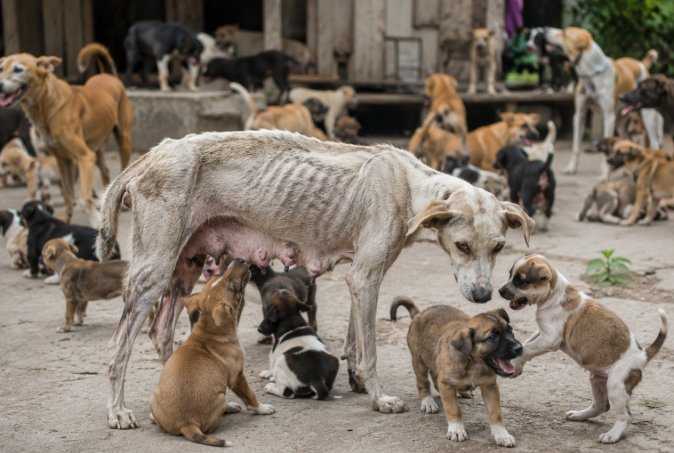
    Bali dog sterilisation is urgently needed for street dogs like this nursing mother

    That figure is not guesswork, and it is not inflated. Bali’s Dinas Pertanian dan Ketahanan Pangan recorded an official dog population of 565,737 in 2025: Badung 95,000, Denpasar 82,545, Karangasem 78,975, Gianyar 78,266, Buleleng 70,298, Tabanan 54,726, Bangli 46,707, Jembrana 41,668, Klungkung 17,552. But in July 2025, after population trials conducted with the World Organisation for Animal Health, the Ministry of Agriculture through BBV Denpasar stated that the real population is larger than the official estimate and that the counting method would have to be revised. The government has said, on its own record, that its own number is too low.

    That admission carries further than it looks. Reported rabies vaccination coverage for 2025 was 85.35 per cent, or 482,868 dogs, but that percentage is calculated against a denominator the government itself has already disowned. Measured against a population nearer 700,000, the same 482,868 dogs represent roughly 69 per cent. And the average conceals where the shortfall sits: Karangasem reached 96.25 per cent, while Buleleng, the regency containing Singaraja, vaccinated 51,885 of 70,298 dogs, roughly 74 per cent. Sixteen people died of rabies in Bali in 2025, out of 66,760 recorded bites.

    Yearly data and numbers may change, following developments we cannot predict. But the fact remains that a single female dog can have 70 to 90 pups in her lifetime, more in the large breeds, and her pups will have more. These are the points I want to raise, and what I want people to be aware of.

    The peak of fertility in dogs occurs between 2 and 5 years of age. A female dog’s first litter is typically smaller than average, and litter sizes steadily decline after age 5 or 6 as fertility decreases and reproductive risks rise. But female dogs can still get pregnant and give birth outside that 2 to 5 year peak window, both before they turn 2 and long after they turn 5.

    Unlike humans, female dogs do not go through menopause. An intact female dog remains biologically capable of coming into heat and conceiving throughout her entire life, right into her senior years, unless she is STERILISED (SPAYED).

    Street dog nursing a litter in Bali before sterilisation

    In older dogs, age 6 and above, fertility naturally declines, often resulting in smaller litters or a higher likelihood of unfertilised eggs, but she can still become pregnant. However, pregnancy in senior dogs carries severe health risks. Older females face a dramatically higher risk of life threatening uterine infections like pyometra, labour complications (dystocia), high maternal mortality, and severe physical exhaustion from nursing.

    At the other end of her life the danger is just as sharp. Young dogs under 2 years can get pregnant during their very first heat cycle, which often occurs between 6 and 12 months of age depending on the breed. Because her skeleton and organs are not yet fully grown, carrying a litter this early poses serious risks of birth complications, and young mothers often struggle with maternal instincts or physical milk production.

    Between those two points, there is no safe pause. Because an older female’s body continues to cycle every 6 to 8 months regardless of age, the biological drive and capacity to reproduce never naturally stop. Without Bali dog sterilisation reaching her, a senior female remains constantly vulnerable to accidental pregnancies that her ageing body cannot easily handle.

    Veterinary and health reality: while a dog can physically bear litters back to back during consecutive heat cycles, doing so severely depletes her physical reserves and increases the risk of uterine infections, malnutrition, and birth complications.

    On average, a female dog will produce between 15 to 30 puppies in her lifetime under managed, responsible conditions. However, if an unspayed female dog breeds continuously throughout her entire life without intervention, she can physically give birth to 70 to 90 puppies over her lifespan, and considerably more in the largest breeds.

    Female dog nursing a large litter of puppies

    The uncontrolled biological maximum sits higher still. An intact female dog cycles about twice a year from age 1 through her senior years, ages 9 to 11+. If she conceives during every heat cycle over a decade, she can produce 15 to 20 litters. Across her entire lifespan, an unspayed female can directly give birth to between 70 and 90 puppies.

    Small breeds (Chihuahuas, Pomeranians): 10 to 25 puppies lifetime maximum, due to smaller litters of 1 to 4 pups. Medium breeds (Beagles, Spaniels): 35 to 60 puppies lifetime maximum, at 5 to 7 pups per litter. Large and giant breeds (Labradors, Mastiffs): 70 to 120+ puppies lifetime maximum, due to large litters of 8 to 12+ pups.

    The exponential descendant impact is the part people miss. One female dog directly bears several dozen puppies herself, but her actual population impact expands exponentially. If her puppies and their offspring are also left unspayed and unneutered, a single female and her immediate line can contribute to thousands of stray or homeless dogs in just 4 to 6 generations. Mass culling in Bali will continue. There are not enough rescuers to save them, and the bottom line is that these dogs always bear the pain.

    And culling has already been tested here, at scale, with a documented result. Between 2008 and 2011, approximately 108,000 dogs were killed in Bali in response to rabies. Peer reviewed analysis published in PLOS One found that culling did not reduce rabies cases and did not prevent the disease from spreading across the island. The dogs died. The problem did not.

    One intervention actually works, and one choice about who it is performed on

    Sterilise a male, and another male replaces him within days. The females around him remain intact and nothing changes. Sterilise one female, and every number above this line becomes zero: the two litters a year, the 70 to 90 across her lifetime, the thousands across four to six generations. Female surgery costs more and takes longer to recover from, which is exactly why underfunded programmes do males instead, and exactly why the population never falls.

    What Bali dog sterilisation actually costs

    In Singaraja, working with a local vet, Bali dog sterilisation costs 500,000 rupiah per dog, and a trip only runs with a minimum of around ten dogs. Other areas may cost more.

    That minimum is the part almost nobody sees. This work is not funded per dog; it is funded per trip. I cannot drive to Singaraja for one female. The smallest action that is physically possible costs 5,000,000 rupiah, and below that threshold nothing moves at all. Ten females sterilised removes somewhere between 80 and 120 puppies from the street every year, for the rest of their lives.

    Why that money does not arrive

    Donors fund what they can see. Places with tourists produce photographs, photographs produce posts, posts produce donations. Places without tourists produce none of that, so the dogs there go unfunded, not because the need is smaller but because nobody is looking. Requests for Bali dog sterilisation reach me from everywhere, Singaraja and Denpasar and everywhere between. That is not a shortage of need. It is a shortage of anyone going.

    Funded tourist area contrasted with an unfunded village in Bali

    What I can carry and what I cannot

    I have paid for some of this myself, and much of it I have carried without anyone knowing. Every sterilisation, every course of medication, every trip, out of my own pocket, alongside everything else I am responsible for.

    If you fund a dog, you will see that dog…..

    What I cannot do is carry it indefinitely alone. Every rupiah is one female who will never produce another litter. Every ten is one trip that becomes possible.

    Fund one female for Bali dog sterilisation. That is the whole request.

    [DONATE – AbyssPaws]

    Each round added here by date, location, number of dogs, and cost.

    Sources

  • Catch-Neuter-Vaccinate-Return: The Humane Way to End Rabies and Manage Bali’s Street Dogs

    Catch-Neuter-Vaccinate-Return: The Humane Way to End Rabies and Manage Bali’s Street Dogs

    Every time a rabies scare hits the news, the same old reflex returns: round up the street dogs and kill them. It feels decisive. It feels like action. And it fails, every single time. The population rebounds within months, the disease keeps spreading, and the cycle of killing and spending starts all over again.

    my daughter feeding street dogs on a Bali beach, CNVR in action

    There is a better way, and it is not a theory. Catch-Neuter-Vaccinate-Return (CNVR) is a scientifically proven, humane strategy used across the world to control free-roaming dog populations and eliminate rabies at its source. It is recognised by the World Health Organization and the International Companion Animal Management (ICAM) Coalition as the global gold standard. The science is settled. What is missing here is the will to apply it fully, and everywhere, not just in a handful of chosen districts.

    Two Groups, One Clear Answer

    When researchers study whether CNVR actually works, they compare two groups: intervention areas, where dogs are caught, sterilised, vaccinated, and returned to their exact home territory, and control areas, where nothing structured is done. The contrast is stark.

    In CNVR areas, the results build steadily over time:

    • Population stabilises and declines. Breeding on the streets stops entirely. A five-year, high-intensity CNVR programme across Greater Bangkok, covering nearly 300,000 dogs, produced a measurable reduction in free-roaming dog density of almost 25% over five years.
    • Rabies drops toward zero. Once vaccination coverage passes the critical threshold, monthly rabies cases fall consistently.
    • Fewer dog bites. Neutered dogs lose the hormonal aggression that spikes during mating season, so territorial and mating-driven attacks decline.
    • The community warms to the dogs. That same programme recorded a 39% yearly increase in free-roaming dogs showing visible signs of ownership or care, food, water, shelter, as residents reported less trouble and more comfort living alongside them.

    In control areas, where dogs are left unmanaged or simply killed, the opposite unfolds:

    • The population explodes. High birth rates and high puppy mortality keep the cycle spinning.
    • Rabies persists. The unvaccinated population stays a permanent reservoir for the virus.
    • The vacuum effect kicks in. Remove dogs without sterilising, and the empty territory is instantly refilled by migrating dogs or fresh litters from the intact dogs left behind. You cannot kill your way out of it.
    • Fear runs high. In one household survey in Bhutan, around 90% of the community viewed stray dogs as a problem to society and 77% saw them as a direct threat to human health. Notably, 84% still favoured birth control over killing as the solution.
    my son feeding street dogs on a Bali beach, CNVR in action

    The Vacuum Effect: Why Culling Always Fails

    This is the single most important thing for any policymaker to understand. Culling does not create a lasting empty space. It creates an opportunity. Every dog removed leaves a resource-rich gap that surviving and incoming dogs rush to fill, and they breed faster to do it. Bali learned this the hard way: during its rabies outbreak, roughly 108,000 dogs were culled with no lasting effect on the spread of the disease. The killing was not just cruel, it was useless.

    The related trap is the external inflow problem. Even a successful CNVR zone can be undermined by abandoned, lost, or intact owned dogs migrating in from surrounding areas. This is why the real solution is not just catching street dogs, but scaling the programme to cover owned neighbourhood pets too, and tackling abandonment at the same time.

    It Works Everywhere, and It Has for Decades

    CNVR is not a Western experiment being tested on Bali. It is a global standard, actively running across Asia (India, Thailand, Bhutan, Sri Lanka), Europe (Turkey, Romania, Greece), and Latin America (Chile, Colombia, Brazil).

    The concept began as Trap-Neuter-Return in the United Kingdom and Europe in the 1950s and 1960s, used by animal welfare pioneers to manage feral cat colonies. Adding the “V” for vaccination, specifically to fight canine rabies, came later through collaboration between the WHO, the World Organisation for Animal Health, and global veterinary groups.

    And the proof that it works at national scale? Mexico. In November 2019, Mexico became the first country in the world to receive official WHO validation for eliminating dog-transmitted rabies as a public health problem. It did not invent CNVR. It simply committed to decades of continuous mass vaccination and free sterilisation, and it worked. Human deaths from dog-mediated rabies fell from around 600 a year in the 1980s to zero. That is what political will looks like, applied nationwide and sustained, not started and abandoned.

    Is It More Expensive Than Culling? Only If You Cannot Count

    Upfront, yes, CNVR costs more. It needs surgical equipment, anaesthetic, trained veterinary staff, and field logistics. But that is a front-loaded, one-time-heavy investment, and governments are well placed to meet it by mobilising volunteers, international funding, and donated medication.

    Over the long run, culling is far more expensive, because it never ends:

    Culling: high expense → dogs killed → population rebounds → repeat the high expense, forever.

    CNVR: high expense → dogs sterilised → population declines → costs fall toward zero as the population stabilises.

    One is a bottomless pit. The other is an investment that pays itself off.

    dogs on a Bali beach, CNVR is the best option

    How Fast Does It Work?

    Two different clocks are running here, and it matters that people understand both:

    • Rabies suppression is fast. Vaccinate 70% to 80% of the dog population and you reach herd immunity. Transmission drops toward zero within one to two years. This 70% threshold is the WHO’s empirically established target, backed by decades of field evidence.
    • Population decline is gradual. It takes three to five years of sustained operations to see a visible drop in the number of street dogs, as the sterilised generation naturally ages out. There is no overnight visual fix, and honesty about that is important.

    Bali has already proven the first clock, at least in the areas where the work was actually done. During its rabies outbreak, an island-scale campaign vaccinated over 200,000 dogs and pushed coverage toward 70% in many areas. Monthly confirmed dog rabies cases fell from about 45 before vaccination to around 6, and monthly human deaths dropped sharply. Vaccination did in months what years of culling had failed to do. The catch is that the effort was not sustained evenly or everywhere, which is exactly why rabies has never been fully eliminated from the island. Selective, stop-start coverage is not the same as commitment.

    The Honest Downsides

    I will not sugarcoat it. CNVR has real limits:

    • No instant visual fix. The dogs return to the streets to live out their lives. If someone wants them to simply vanish tomorrow, this is not that.
    • The vacuum effect risk remains. Stop too early, or fail to hit 70%, and intact dogs migrate in and numbers bounce straight back.
    • It demands ongoing management. Strict data tracking, community coordination, and constant monitoring to catch new, unsterilised, or abandoned animals

    These are not reasons to reject CNVR. They are reasons to do it properly, everywhere, and to keep going.

    How Bali Could Move Fast

    1. Deploy Oral Rabies Vaccines (ORV). Instead of manually catching and injecting every dog, distribute dog-friendly baits containing oral vaccine. Field trials in Bali showed that local cattle-intestine and egg-flavoured baits make mass vaccinating free-roaming dogs dramatically faster and easier.
    2. Launch mobile spay and neuter clinics. Retrofitted trucks target one zone at a time, maximising local coverage before moving to the next district.
    3. Register and map community dogs. Engage the banjar and local village leaders to identify, track, and monitor free-roaming dogs using simple mobile apps.

    One firm line on welfare and safety: field catching can be done by trained volunteers and community members, but the sterilisation itself must be performed only by licensed veterinarians in clean, secure surgical conditions. No shortcuts on that.

    This Is the Government’s Job

    Yes, absolutely. Public health and safety are core government responsibilities. Leaning entirely on scattered animal welfare efforts is not sustainable, and it never will be, especially when that work only ever reaches selected pockets of the island while the rest is left to fend for itself. Indonesia’s Health Ministry has already proposed mass vaccination to break the chain of rabies transmission in Bali. The knowledge exists. The proof exists. What is needed now is for the Bali government to codify CNVR into local policy, allocate real budget, and run public education alongside the veterinary work, across every regency, not just the convenient ones.

    I will keep doing my part, under AbyssPaws, discussing and lobbying at every level I can reach, online, at the banjar level, and with government, within my limitations. If enough of us push, this can be implemented properly in Bali, then across Indonesia, and eventually far beyond it. The dogs did not choose this. We can choose to do right by them, and protect ourselves at the same time.

    SOURCES:

    🐾 Help make this real. AbyssPaws funds sterilisation and rabies vaccination for street and community dogs across Bali, dog by dog, with full transparency. If this article moved you, the best thing you can do is share it. And if you’re able to give, every rupiah goes straight to dogs no one else is paying for. → See how to support AbyssPaws


  • Bali Street Dogs: The Law Says Protect, Reality Says Otherwise

    Bali Street Dogs: The Law Says Protect, Reality Says Otherwise

    Under Indonesian law, protecting Bali street dogs is not a favour the government does when it feels generous. It is a legal obligation, a shared responsibility between central authorities, regional governments, and civil society, written into Law Number 41 of 2014 on Animal Husbandry and Animal Health. On paper, Bali has some of the most progressive animal-welfare commitments in the country. In practice, the dogs on the street tell a different story.

    This is the gap between what the law promises and what actually happens on the ground, and it is the gap that groups like AbyssPaws exist to fill.

    What the Law Actually Requires

    Bali’s obligations toward its estimated 500,000 to 600,000 roaming dogs are not vague. They are specific, and they sit on four clear legal and practical fronts.

    Mandatory mass vaccination. The government’s primary legal duty is disease control to protect public health. Bali has publicly committed to becoming rabies-free by 2028, and to get there, local agriculture and health services are obligated to run free, island-wide anti-rabies vaccination drives reaching at least 70% of the dog population, the threshold scientists say is needed for herd immunity.

    A ban on the dog meat trade. In a genuinely historic move, the Bali Governor enacted Regional Regulation Number 5 of 2023, which officially bans the trade and distribution of dog meat across the province, the first regulation of its kind in Indonesia. Violations are a criminal offence carrying up to three months’ imprisonment and heavy fines.

    Bali street dog waiting for rescue and sterilisation

    Protection of the native Bali Dog. To guard the genetic purity of the indigenous Bali Dog, one of the world’s oldest pristine dog populations, and to block imported disease, the government enforces strict quarantine and entry laws that make it illegal to bring outside dogs onto the island.

    Enforcing owner responsibility. The government itself acknowledges that many “stray” dogs actually belong to village compounds but are left to roam. Under regional rabies bylaws, authorities are obligated to enforce rules requiring owners to confine and vaccinate their animals.

    Read together, this is a serious framework. A government following it would be vaccinating relentlessly, funding the shelters and sterilisation programs that keep populations stable, and treating culling as the failed policy the science has already proven it to be.

    Where the Promise Breaks

    Here is the problem. While the government manages the high-level logistics of mass vaccination and health regulation, it provides very little funding or infrastructure for the parts that actually keep Bali street dogs alive and populations under control: shelters, rescue, sterilisation, and rehabilitation. That work is left almost entirely to independent non-profits.

    And when outbreaks flare and political pressure rises, the temptation to reach for the oldest, crudest tool returns: the indiscriminate cull.

    The tragedy is that the government already knows this does not work. Bali’s own rabies history is a documented lesson in it. After the 2008 outbreak, authorities leaned on mass culling by strychnine poisoning; a practice condemned worldwide. It failed. It was only when the strategy shifted toward comprehensive vaccination, and free-roaming dogs were recognised as part of the solution rather than the enemy, that human rabies cases finally began to fall. Even the Food and Agriculture Organization has documented this paradigm shift on Bali directly.

    So when culling returns, it is not a policy gap born of ignorance. It is a choice to ignore what is already known.

    Bali street dog after vaccination

    Why the Cull Backfires; Every Time

    Global health authorities, including the World Health Organization and the FAO, have proven definitively that indiscriminate culling does not eliminate rabies and actually makes outbreaks worse. When a government takes this shortcut, the damage lands in four places at once.

    It destroys herd immunity; the “vaccine vacuum.” Street catchers easily capture the friendly, healthy, already-vaccinated dogs. The truly fearful or rabid ones run and hide. Removing vaccinated dogs from a neighbourhood leaves behind a resource vacuum; food waste, shelter, empty territory; that unvaccinated, potentially rabid dogs from other areas rush in to fill and breed. The cull doesn’t stop rabies. It accelerates it.

    It damages tourism. Bali’s economy depends on its reputation as a peaceful paradise. When graphic footage of dog culls reaches international media, it triggers global outrage. Organisations like PETA and World Animal Protection have launched campaigns urging tourists to boycott the island, and many compassionate travellers quietly avoid destinations known for cruel, indiscriminate slaughter.

    It erodes a unique heritage breed. The Bali Dog is genetically distinct and ancient, one of the oldest pristine dog populations on earth. Indiscriminate culling pushes this indigenous breed closer to extinction, destroying a living piece of Bali’s bio-cultural heritage for a short-term political cosmetic that doesn’t even work.

    rescued Bali dog recovering

    It violates local culture and religion. Balinese life is rooted in Tri Hita Karana, the philosophy of harmony between humans, the divine, and nature, animals included. Dogs hold a real place in Balinese spiritual life, often seen as guardians. Forcing communities and village leaders to permit the slaughter of neighbourhood dogs inflicts genuine moral distress and cuts against indigenous spiritual values.

    The Gap We Work In for Bali Street Dogs

    When a government neglects its duty to vaccinate and chooses to kill instead, the rabies virus wins. The dog population becomes unstable, human deaths tend to rise, tourism revenue falls, and local non-profits are left to pick up the pieces of a fractured community.

    That is the gap AbyssPaws works in. Not because it should be our job alone; the law is clear that it is a shared responsibility, but because someone has to do the vaccinating, sterilising, and rescuing that eeps these Bali street dogs alive while the promise on paper waits to be kept.

    Source:

    The Indonesian Veterinary Association on the shift to observation and humane euthanasia – PDHI Bali

    Law Number 41 of 2014 and the shared responsibility for animal welfare – Kompas

    Bali’s target of becoming rabies-free by 2028 – Bali International Hospital

    Indonesia’s 70% vaccination coverage target for herd immunity – Food and Agriculture Organization (FAO)

    Bali Regional Regulation Number 5 of 2023 banning the dog meat trade – Sintesia Animalia Indonesia

    Strict animal quarantine and entry laws protecting the Bali Dog – Merusaka

    How Bali shifted from culling to vaccination, and why free-roaming dogs became key to rabies control – FAO One Health

    International condemnation of dog culling in Bali – World Animal Protection

    PETA’s response to Bali’s dog-killing campaigns – The World

    🐾 Help make this real. AbyssPaws funds sterilisation and rabies vaccination for street and community dogs across Bali, dog by dog, with full transparency. If this article moved you, the best thing you can do is share it. And if you’re able to give, every rupiah goes straight to dogs no one else is paying for. → See how to support AbyssPaws


  • The Cheapest Dog in Bali Is the Oldest Dog on Earth

    The Cheapest Dog in Bali Is the Oldest Dog on Earth

    There is a Bali heritage dog sleeping in a gutter in Tabanan right now that carries more genetic history than every pedigree champion in Jakarta combined.

    Nobody wants her. She is brown, medium-sized, has a slightly crooked ear and a tail that curls the wrong way. She is worth nothing. If you tried to give her away, people would ask what breed she is, and when you said anjing kampung, the conversation would end.

    Two kilometres away, someone is paying eight million rupiah for a puppy that cannot breathe properly.

    I want to explain, carefully and with evidence, exactly how backwards this is.

    What the science says about the Bali heritage dog

    Between 2000 and 2003, DNA samples were taken from three thousand indigenous dogs across Bali and analysed at the Veterinary Genetics Laboratory at UC Davis in California.

    The results were not subtle.

    The published microsatellite study found the Bali street dog to be the most genetically heterogeneous population in the comparison, carrying 239 of the 366 total alleles observed across all groups tested, including twenty-eight American Kennel Club breeds and the Australian dingo. Thirteen alleles appeared only in the Bali dog. The conclusion drawn was that a viable, diverse dog population existed on this island before its geographic isolation roughly twelve thousand years ago, and has stayed largely untouched by European breeds since.

    Dr Ben Sacks of UC Davis has described the modern dog as emerging in Southeast Asia around seven thousand years ago, spreading outward and eventually giving rise to the Kintamani, the chow chow, the Akita, the saluki, the basenji. The Bali heritage dog has been breeding true here for at least 2,500 years.

    Read that again. The pedigree breeds people queue up to buy are, in a real sense, descendants of the dog nobody wants.

    bali heritage dog playing

    The scorned village dog is not a mongrel. She is the original.

    What “cute” costs

    Now look at what the money buys instead.

    A 2017 analysis of insurance claims by the American insurer Nationwide found that flat-faced breeds faced more than a 100% increase in the likelihood of claims for corneal ulcers and eye trauma, over 80% more for skin cancer and fungal skin disease, and more than 100% more for pneumonia and heat stroke.

    Brachycephalic obstructive airway syndrome, the condition where a dog’s skull has been selectively shortened until the airway no longer fits inside it, produces exercise intolerance, heat intolerance, sleep disruption, and respiratory distress ranging from mild to fatal. The Netherlands and Norway have introduced legal restrictions on breeding these dogs. Some veterinarians now argue the welfare of several popular breeds is too compromised to justify continuing to breed them at all.

    In a tropical climate. On an island that sits three hundred kilometres from the equator.

    People are importing dogs that cannot cool themselves, into a place where the heat index regularly exceeds thirty-five degrees, because the face looks like a baby’s.

    That is not love. That is shopping.

    Where the puppies come from

    A 2026 investigation by Lady Freethinker and the Jakarta Animal Aid Network mapped a rapidly expanding network of unregulated puppy mills across Indonesia, concentrated in West and Central Java. Dogs crammed into overcrowded cages. No veterinary care. Females bred repeatedly with no recovery. Puppies sold unvaccinated, carrying the risk of parvovirus, distemper and rabies into people’s homes.

    Most of those sales now happen through TikTok, Tokopedia and Shopee. Buyers almost never see the conditions. Breeders refuse property access and bring the dogs out one at a time, which tells you everything about what is behind the gate.

    An earlier PETA Asia investigation of five Indonesian breeding facilities documented dogs standing on bare wire mesh that cut into their paws, enclosures reduced to roughly a square metre, and breeders physically holding two pugs together to force mating. All of it legal.

    And the part that should end the argument permanently: when these operations stop being profitable, investigators heard reports of the surplus dogs being sold into the meat trade.

    bali heritage dog playing at the beach

    So the pedigree puppy in the shop window and the dog in the cage at the market are not opposites. They are two ends of the same supply chain.

    The killing

    Bali was rabies-free until 2008, when the virus arrived from Flores.

    The government’s response, beginning that December, was culling, strychnine-laced baits and blow darts, deployed across Denpasar and Badung. Strychnine does not kill quickly. It kills through hours of convulsions.

    By some counts around two hundred thousand dogs were killed. It did not stop the outbreak. By September 2010 rabies had been confirmed in over 30% of Bali’s villages.

    What did work was vaccination. World Animal Protection reports that its 2010 programme vaccinated 210,000 dogs and produced a 35% drop in human rabies deaths and a 76% drop in rabies in dogs.

    The evidence was in hand fifteen years ago. Culling still returns whenever there is a scare.

    BAWA estimates the free-ranging indigenous Bali dog population has fallen from around 800,000 to roughly 20,000.

    We are not managing a nuisance. We are erasing a twelve-thousand-year-old lineage, and we are doing it with poison, because we decided it was ugly.

    The actual mechanism

    Here is what is happening underneath all of it, stated plainly.

    The dog’s value is not being assessed. It is being signalled.

    A purebred dog with papers and a price tag communicates something about the person holding the leash; money, taste, arrival, modernity. The dog is a wearable object. The price is the point; if the dog were free, it would not perform the function.

    The village dog fails at this completely. Not because she is less healthy, less intelligent, less loyal or less beautiful, on every measurable axis she outperforms, but because she cannot be shown off. She is what you get when you don’t have money. So she reads as poverty, and people move away from her the way they move away from anything that might stick to them.

    This is why “she’s a stray” is said in the tone it’s said in. It was never a description of the dog. It was a description of the owner.

    And the cruelty of it is circular: the dogs are neglected because they’re considered worthless, and then their neglected condition, the mange, the thinness, the fear, is offered as proof that they were worthless all along.

    What adoption actually is

    Not charity. Not settling. Not the sad option.

    You are taking home an animal with a functioning skull, a working nose, a normal palate, hybrid vigour instead of accumulated recessive disease, and a nervous system shaped by 2,500 years of living alongside humans on this exact island in this exact climate.

    bali heritage dog sleeping and save in a house

    You are also removing one unit of demand from a supply chain that ends in a wire cage in Java, and adding one to a population that vaccination programmes can actually reach.

    You are not rescuing her. She is, statistically and genetically, the better dog. You’re just the one who noticed.

    The honest part

    I am tired.

    I am tired of explaining that a dog’s worth is not printed on a receipt. Tired of watching people step over an animal with an eight-thousand-year pedigree to go and buy something that will need surgery to breathe. Tired of the ones I couldn’t reach in time, and of knowing exactly how the next scare will go, and of the specific silence that follows when you tell someone their dog was never a mongrel.

    There is no clean ending to this. The awareness isn’t coming on its own. It arrives one person at a time, usually because one dog got close enough to be seen properly.

    So: don’t buy. Adopt. Sterilise. Vaccinate. And when someone tells you the village dog is nothing special, you now know enough to tell them what she actually is.

    She was here first. She’ll be here after. She deserves better than the reception she gets on her own island.

    More about the sterilisation and medication rounds at AbyssPaws.

    Sources

    Dog Meat Free Indonesia on extreme markets — the coalition’s position on live animal markets and the legal framework around them.

    Genetic variation analysis of the Bali street dog using microsatellites — the UC Davis microsatellite study on allelic diversity, heterozygosity and the Bali dog’s relationship to the dingo, Akita and Chow Chow.

    BAWA’s Bali Heritage Dog campaign — background on the indigenous Bali dog, the DNA sampling programme, and the breed’s role in Balinese cultural life.

    The Last Bali Heritage Dog — Cat Wheeler — Dr Ben Sacks of UC Davis on the Southeast Asian origin of the modern dog and the Bali dog’s scientific value.

    Indigenous Bali Dogs on Brink of Extinction — DogTime — BAWA’s population estimates and the effect of culling and interbreeding on the heritage dog.

    Response to a Rabies Epidemic, Bali, Indonesia, 2008–2011 — CDC Emerging Infectious Diseases — the official epidemiological account of the outbreak, the culling method, and the failure of the emergency response.

    World Animal Protection’s response to dog culling in Bali — vaccination outcome figures and the case against culling as a rabies strategy.

    Killing 200,000 Dogs Doesn’t Halt Rabies in Bali — CBS News — contemporaneous reporting on the scale of the cull and the vaccine shortages that followed.

    Lady Freethinker and JAAN investigation into Indonesia’s expanding puppy mill industry — conditions inside backyard breeding operations, online sales channels, and the link to the meat trade.

    PETA Asia’s investigation of Indonesian puppy-breeding facilities — documented conditions at five breeding facilities supplying pet shops in Jakarta.

    Unravelling the health status of brachycephalic dogs — Nature Scientific Reports — peer-reviewed evidence on conformation-related disease in flat-faced breeds.

    Consequences and Management of Canine Brachycephaly in Veterinary Practice — veterinary perspectives on extreme morphology as a systemic welfare problem.

    Dermatological Problems of Brachycephalic Dogs — on BOAS, associated non-respiratory disorders, and the breeding restrictions introduced in the Netherlands and Norway.

    The Evolution of Petface — Smithsonian Magazine — the Nationwide insurance claims analysis and the history of how breed standards produced inherited disease.

    10 brachycephalic dog breeds and their health issues — Humane World for Animals — plain-language summary of the conditions these breeds live with.

    The facts on Indonesia’s dog meat trade — Humane World for Animals — consumption figures, rabies risk, and the status of the Animal Protection and Welfare Bill.