
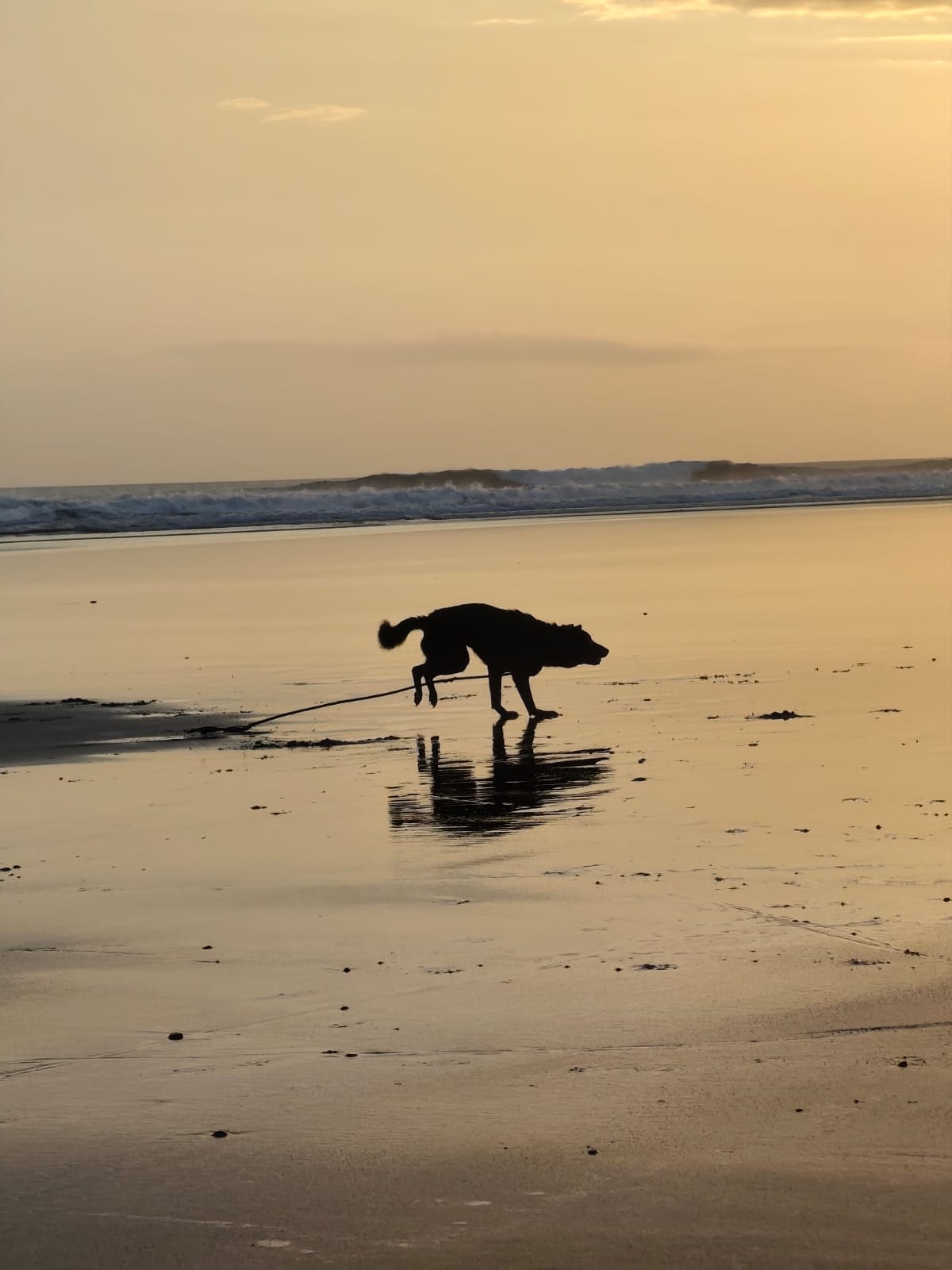
There is a Bali heritage dog sleeping in a gutter in Tabanan right now that carries more genetic history than every pedigree champion in Jakarta combined.
Nobody wants her. She is brown, medium-sized, has a slightly crooked ear and a tail that curls the wrong way. She is worth nothing. If you tried to give her away, people would ask what breed she is, and when you said anjing kampung, the conversation would end.
Two kilometres away, someone is paying eight million rupiah for a puppy that cannot breathe properly.
I want to explain, carefully and with evidence, exactly how backwards this is.
What the science says about the Bali heritage dog
Between 2000 and 2003, DNA samples were taken from three thousand indigenous dogs across Bali and analysed at the Veterinary Genetics Laboratory at UC Davis in California.
The results were not subtle.
The published microsatellite study found the Bali street dog to be the most genetically heterogeneous population in the comparison, carrying 239 of the 366 total alleles observed across all groups tested, including twenty-eight American Kennel Club breeds and the Australian dingo. Thirteen alleles appeared only in the Bali dog. The conclusion drawn was that a viable, diverse dog population existed on this island before its geographic isolation roughly twelve thousand years ago, and has stayed largely untouched by European breeds since.
Dr Ben Sacks of UC Davis has described the modern dog as emerging in Southeast Asia around seven thousand years ago, spreading outward and eventually giving rise to the Kintamani, the chow chow, the Akita, the saluki, the basenji. The Bali heritage dog has been breeding true here for at least 2,500 years.
Read that again. The pedigree breeds people queue up to buy are, in a real sense, descendants of the dog nobody wants.

The scorned village dog is not a mongrel. She is the original.
What “cute” costs
Now look at what the money buys instead.
A 2017 analysis of insurance claims by the American insurer Nationwide found that flat-faced breeds faced more than a 100% increase in the likelihood of claims for corneal ulcers and eye trauma, over 80% more for skin cancer and fungal skin disease, and more than 100% more for pneumonia and heat stroke.
Brachycephalic obstructive airway syndrome, the condition where a dog’s skull has been selectively shortened until the airway no longer fits inside it, produces exercise intolerance, heat intolerance, sleep disruption, and respiratory distress ranging from mild to fatal. The Netherlands and Norway have introduced legal restrictions on breeding these dogs. Some veterinarians now argue the welfare of several popular breeds is too compromised to justify continuing to breed them at all.
In a tropical climate. On an island that sits three hundred kilometres from the equator.
People are importing dogs that cannot cool themselves, into a place where the heat index regularly exceeds thirty-five degrees, because the face looks like a baby’s.
That is not love. That is shopping.
Where the puppies come from
A 2026 investigation by Lady Freethinker and the Jakarta Animal Aid Network mapped a rapidly expanding network of unregulated puppy mills across Indonesia, concentrated in West and Central Java. Dogs crammed into overcrowded cages. No veterinary care. Females bred repeatedly with no recovery. Puppies sold unvaccinated, carrying the risk of parvovirus, distemper and rabies into people’s homes.
Most of those sales now happen through TikTok, Tokopedia and Shopee. Buyers almost never see the conditions. Breeders refuse property access and bring the dogs out one at a time, which tells you everything about what is behind the gate.
An earlier PETA Asia investigation of five Indonesian breeding facilities documented dogs standing on bare wire mesh that cut into their paws, enclosures reduced to roughly a square metre, and breeders physically holding two pugs together to force mating. All of it legal.
And the part that should end the argument permanently: when these operations stop being profitable, investigators heard reports of the surplus dogs being sold into the meat trade.

So the pedigree puppy in the shop window and the dog in the cage at the market are not opposites. They are two ends of the same supply chain.
The killing
Bali was rabies-free until 2008, when the virus arrived from Flores.
The government’s response, beginning that December, was culling, strychnine-laced baits and blow darts, deployed across Denpasar and Badung. Strychnine does not kill quickly. It kills through hours of convulsions.
By some counts around two hundred thousand dogs were killed. It did not stop the outbreak. By September 2010 rabies had been confirmed in over 30% of Bali’s villages.
What did work was vaccination. World Animal Protection reports that its 2010 programme vaccinated 210,000 dogs and produced a 35% drop in human rabies deaths and a 76% drop in rabies in dogs.
The evidence was in hand fifteen years ago. Culling still returns whenever there is a scare.
BAWA estimates the free-ranging indigenous Bali dog population has fallen from around 800,000 to roughly 20,000.
We are not managing a nuisance. We are erasing a twelve-thousand-year-old lineage, and we are doing it with poison, because we decided it was ugly.
The actual mechanism
Here is what is happening underneath all of it, stated plainly.
The dog’s value is not being assessed. It is being signalled.
A purebred dog with papers and a price tag communicates something about the person holding the leash; money, taste, arrival, modernity. The dog is a wearable object. The price is the point; if the dog were free, it would not perform the function.
The village dog fails at this completely. Not because she is less healthy, less intelligent, less loyal or less beautiful, on every measurable axis she outperforms, but because she cannot be shown off. She is what you get when you don’t have money. So she reads as poverty, and people move away from her the way they move away from anything that might stick to them.
This is why “she’s a stray” is said in the tone it’s said in. It was never a description of the dog. It was a description of the owner.
And the cruelty of it is circular: the dogs are neglected because they’re considered worthless, and then their neglected condition, the mange, the thinness, the fear, is offered as proof that they were worthless all along.
What adoption actually is
Not charity. Not settling. Not the sad option.
You are taking home an animal with a functioning skull, a working nose, a normal palate, hybrid vigour instead of accumulated recessive disease, and a nervous system shaped by 2,500 years of living alongside humans on this exact island in this exact climate.

You are also removing one unit of demand from a supply chain that ends in a wire cage in Java, and adding one to a population that vaccination programmes can actually reach.
You are not rescuing her. She is, statistically and genetically, the better dog. You’re just the one who noticed.
The honest part
I am tired.
I am tired of explaining that a dog’s worth is not printed on a receipt. Tired of watching people step over an animal with an eight-thousand-year pedigree to go and buy something that will need surgery to breathe. Tired of the ones I couldn’t reach in time, and of knowing exactly how the next scare will go, and of the specific silence that follows when you tell someone their dog was never a mongrel.
There is no clean ending to this. The awareness isn’t coming on its own. It arrives one person at a time, usually because one dog got close enough to be seen properly.
So: don’t buy. Adopt. Sterilise. Vaccinate. And when someone tells you the village dog is nothing special, you now know enough to tell them what she actually is.
She was here first. She’ll be here after. She deserves better than the reception she gets on her own island.
More about the sterilisation and medication rounds at AbyssPaws.
Sources
Dog Meat Free Indonesia on extreme markets — the coalition’s position on live animal markets and the legal framework around them.
Genetic variation analysis of the Bali street dog using microsatellites — the UC Davis microsatellite study on allelic diversity, heterozygosity and the Bali dog’s relationship to the dingo, Akita and Chow Chow.
BAWA’s Bali Heritage Dog campaign — background on the indigenous Bali dog, the DNA sampling programme, and the breed’s role in Balinese cultural life.
The Last Bali Heritage Dog — Cat Wheeler — Dr Ben Sacks of UC Davis on the Southeast Asian origin of the modern dog and the Bali dog’s scientific value.
Indigenous Bali Dogs on Brink of Extinction — DogTime — BAWA’s population estimates and the effect of culling and interbreeding on the heritage dog.
Response to a Rabies Epidemic, Bali, Indonesia, 2008–2011 — CDC Emerging Infectious Diseases — the official epidemiological account of the outbreak, the culling method, and the failure of the emergency response.
World Animal Protection’s response to dog culling in Bali — vaccination outcome figures and the case against culling as a rabies strategy.
Killing 200,000 Dogs Doesn’t Halt Rabies in Bali — CBS News — contemporaneous reporting on the scale of the cull and the vaccine shortages that followed.
Lady Freethinker and JAAN investigation into Indonesia’s expanding puppy mill industry — conditions inside backyard breeding operations, online sales channels, and the link to the meat trade.
PETA Asia’s investigation of Indonesian puppy-breeding facilities — documented conditions at five breeding facilities supplying pet shops in Jakarta.
Unravelling the health status of brachycephalic dogs — Nature Scientific Reports — peer-reviewed evidence on conformation-related disease in flat-faced breeds.
Consequences and Management of Canine Brachycephaly in Veterinary Practice — veterinary perspectives on extreme morphology as a systemic welfare problem.
Dermatological Problems of Brachycephalic Dogs — on BOAS, associated non-respiratory disorders, and the breeding restrictions introduced in the Netherlands and Norway.
The Evolution of Petface — Smithsonian Magazine — the Nationwide insurance claims analysis and the history of how breed standards produced inherited disease.
10 brachycephalic dog breeds and their health issues — Humane World for Animals — plain-language summary of the conditions these breeds live with.
The facts on Indonesia’s dog meat trade — Humane World for Animals — consumption figures, rabies risk, and the status of the Animal Protection and Welfare Bill.
🐾 Help make this real. AbyssPaws funds sterilisation and rabies vaccination for street and community dogs across Bali, dog by dog, with full transparency. If this article moved you, the best thing you can do is share it. And if you’re able to give, every rupiah goes straight to dogs no one else is paying for. → See how to support AbyssPaws


Leave a Reply