
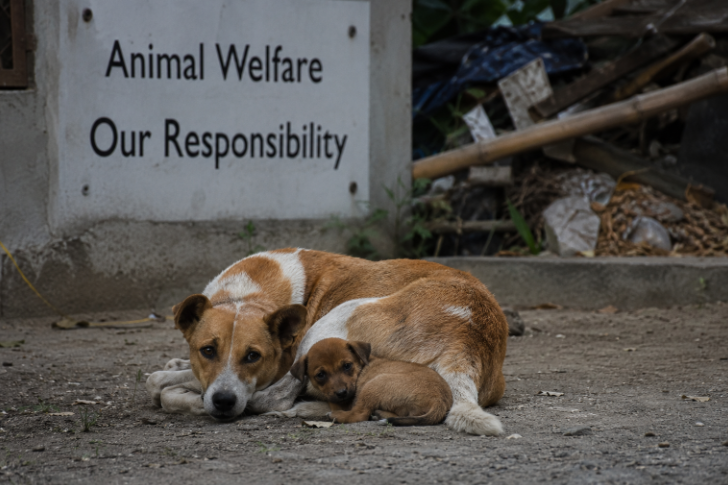
Under Indonesian law, protecting Bali street dogs is not a favour the government does when it feels generous. It is a legal obligation, a shared responsibility between central authorities, regional governments, and civil society, written into Law Number 41 of 2014 on Animal Husbandry and Animal Health. On paper, Bali has some of the most progressive animal-welfare commitments in the country. In practice, the dogs on the street tell a different story.
This is the gap between what the law promises and what actually happens on the ground, and it is the gap that groups like AbyssPaws exist to fill.
What the Law Actually Requires
Bali’s obligations toward its estimated 500,000 to 600,000 roaming dogs are not vague. They are specific, and they sit on four clear legal and practical fronts.
Mandatory mass vaccination. The government’s primary legal duty is disease control to protect public health. Bali has publicly committed to becoming rabies-free by 2028, and to get there, local agriculture and health services are obligated to run free, island-wide anti-rabies vaccination drives reaching at least 70% of the dog population, the threshold scientists say is needed for herd immunity.
A ban on the dog meat trade. In a genuinely historic move, the Bali Governor enacted Regional Regulation Number 5 of 2023, which officially bans the trade and distribution of dog meat across the province, the first regulation of its kind in Indonesia. Violations are a criminal offence carrying up to three months’ imprisonment and heavy fines.

Protection of the native Bali Dog. To guard the genetic purity of the indigenous Bali Dog, one of the world’s oldest pristine dog populations, and to block imported disease, the government enforces strict quarantine and entry laws that make it illegal to bring outside dogs onto the island.
Enforcing owner responsibility. The government itself acknowledges that many “stray” dogs actually belong to village compounds but are left to roam. Under regional rabies bylaws, authorities are obligated to enforce rules requiring owners to confine and vaccinate their animals.
Read together, this is a serious framework. A government following it would be vaccinating relentlessly, funding the shelters and sterilisation programs that keep populations stable, and treating culling as the failed policy the science has already proven it to be.
Where the Promise Breaks
Here is the problem. While the government manages the high-level logistics of mass vaccination and health regulation, it provides very little funding or infrastructure for the parts that actually keep Bali street dogs alive and populations under control: shelters, rescue, sterilisation, and rehabilitation. That work is left almost entirely to independent non-profits.
And when outbreaks flare and political pressure rises, the temptation to reach for the oldest, crudest tool returns: the indiscriminate cull.
The tragedy is that the government already knows this does not work. Bali’s own rabies history is a documented lesson in it. After the 2008 outbreak, authorities leaned on mass culling by strychnine poisoning; a practice condemned worldwide. It failed. It was only when the strategy shifted toward comprehensive vaccination, and free-roaming dogs were recognised as part of the solution rather than the enemy, that human rabies cases finally began to fall. Even the Food and Agriculture Organization has documented this paradigm shift on Bali directly.
So when culling returns, it is not a policy gap born of ignorance. It is a choice to ignore what is already known.

Why the Cull Backfires; Every Time
Global health authorities, including the World Health Organization and the FAO, have proven definitively that indiscriminate culling does not eliminate rabies and actually makes outbreaks worse. When a government takes this shortcut, the damage lands in four places at once.
It destroys herd immunity; the “vaccine vacuum.” Street catchers easily capture the friendly, healthy, already-vaccinated dogs. The truly fearful or rabid ones run and hide. Removing vaccinated dogs from a neighbourhood leaves behind a resource vacuum; food waste, shelter, empty territory; that unvaccinated, potentially rabid dogs from other areas rush in to fill and breed. The cull doesn’t stop rabies. It accelerates it.
It damages tourism. Bali’s economy depends on its reputation as a peaceful paradise. When graphic footage of dog culls reaches international media, it triggers global outrage. Organisations like PETA and World Animal Protection have launched campaigns urging tourists to boycott the island, and many compassionate travellers quietly avoid destinations known for cruel, indiscriminate slaughter.
It erodes a unique heritage breed. The Bali Dog is genetically distinct and ancient, one of the oldest pristine dog populations on earth. Indiscriminate culling pushes this indigenous breed closer to extinction, destroying a living piece of Bali’s bio-cultural heritage for a short-term political cosmetic that doesn’t even work.

It violates local culture and religion. Balinese life is rooted in Tri Hita Karana, the philosophy of harmony between humans, the divine, and nature, animals included. Dogs hold a real place in Balinese spiritual life, often seen as guardians. Forcing communities and village leaders to permit the slaughter of neighbourhood dogs inflicts genuine moral distress and cuts against indigenous spiritual values.
The Gap We Work In for Bali Street Dogs
When a government neglects its duty to vaccinate and chooses to kill instead, the rabies virus wins. The dog population becomes unstable, human deaths tend to rise, tourism revenue falls, and local non-profits are left to pick up the pieces of a fractured community.
That is the gap AbyssPaws works in. Not because it should be our job alone; the law is clear that it is a shared responsibility, but because someone has to do the vaccinating, sterilising, and rescuing that eeps these Bali street dogs alive while the promise on paper waits to be kept.
The law already says protect them. We are simply doing what it asks, in the space the government leaves empty.
Source:
The Indonesian Veterinary Association on the shift to observation and humane euthanasia – PDHI Bali
Law Number 41 of 2014 and the shared responsibility for animal welfare – Kompas
Bali’s target of becoming rabies-free by 2028 – Bali International Hospital
Indonesia’s 70% vaccination coverage target for herd immunity – Food and Agriculture Organization (FAO)
Bali Regional Regulation Number 5 of 2023 banning the dog meat trade – Sintesia Animalia Indonesia
Strict animal quarantine and entry laws protecting the Bali Dog – Merusaka
How Bali shifted from culling to vaccination, and why free-roaming dogs became key to rabies control – FAO One Health
International condemnation of dog culling in Bali – World Animal Protection
PETA’s response to Bali’s dog-killing campaigns – The World
🐾 Help make this real. AbyssPaws funds sterilisation and rabies vaccination for street and community dogs across Bali, dog by dog, with full transparency. If this article moved you, the best thing you can do is share it. And if you’re able to give, every rupiah goes straight to dogs no one else is paying for. → See how to support AbyssPaws
Leave a Reply