
Tag: work permit

  • The Mirage of Paradise: When a Cultural Soul Becomes a Commodity

    The Mirage of Paradise: When a Cultural Soul Becomes a Commodity

    Expat enclaves in Bali fail for reasons that have almost nothing to do with internet drama and everything to do with the real world lens of day to day life. The painful truth is that the Bali of the travel brochures is slowly being suffocated. Millions of foreigners arrive each year drawn by a specific word: “Paradise.” But for too many, that word is merely a code for an affordable playground, a place to exploit resources, extract financial benefits, and accumulate wealth without ever feeling an obligation to give anything back to the island that sustains them.

    This economic extraction is mathematically and visually proven by the hyper-development choking areas like Canggu, Seminyak, and Kuta. These are not cultural centers; they are vibe-checked, high-density residential zones that hold virtually none of the literal Balinese soul found in places like Tabanan or Karangasem. What we are witnessing is not cultural integration, but systemic exploitation. When a famous island is reduced to a commercial pipeline meant to enrich a select few while pricing out and shutting out the local population, the social contract breaks. Exclusive enclaves are not an accident; they are the logical endpoint of turning a living culture into a transaction.

    The Sandcastle Trap: Why Expat Enclaves in Bali Are a Business Liability

    Many foreign directors, investors, and startup founders view cultural friction as a minor public relations issue. This is a critical, often fatal, mistake. In Indonesia, socio-cultural sentiment directly drives political and legal enforcement. When an expat-led venture isolates itself or discriminates against the local population, the backlash ripples far beyond social media comments. It triggers immediate regulatory oversight, multi-agency immigration raids, and aggressive tax audits.

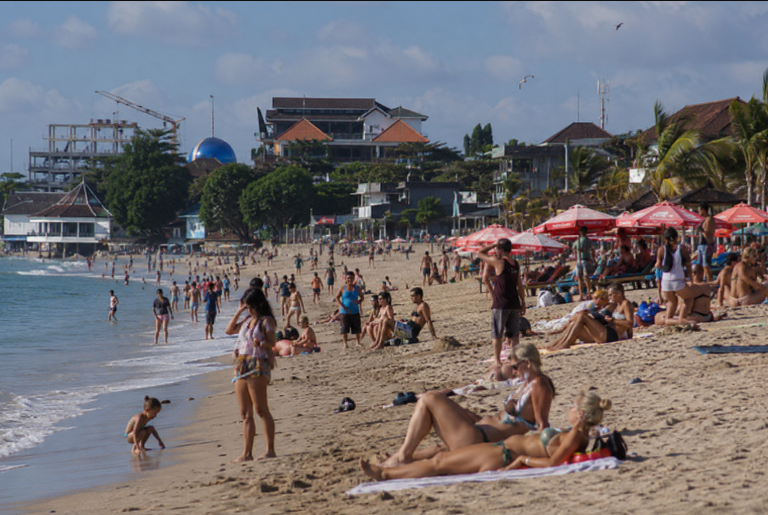
    Expat enclaves in Bali reshaping a busy Canggu street

    The scale involved makes that exposure concrete. Statistics Indonesia recorded 6,948,754 direct foreign arrivals to Bali in 2025, close to ten percent up on the previous year. Enforcement has tightened in step. Immigration authorities logged 2,669 deportations and 2,009 detentions of foreign nationals nationally between January and July 2025, and Bali now runs dedicated patrols targeting foreigners suspected of disturbing public order or ignoring local rules. Expat enclaves in Bali often assume that volume offers cover, that being one bubble among many makes you invisible. The opposite is true. The larger and more visible the expat enclaves in Bali become, the faster a single complaint travels from a neighbourhood WhatsApp group to an immigration desk, and the more attractive that enclave becomes as a demonstration case.

    Building a business inside an exclusive bubble is like building a castle made of sand. It takes only one leaked message or one public controversy for the tide of local enforcement to wash it away entirely. For foreign entities, genuine community integration and compliance are not optional ethical choices; they are the ultimate safeguards for your capital, your visas, and your legal right to operate.

    To navigate the complex realities of local compliance and avoid structural risks, explore our tailored market entry frameworks on the Consulting Contact page.

    Real Integration Starts from the Ground Up

    If the failure of expat enclaves in Bali proves anything, it is that you cannot love this island while ignoring the challenges its ecosystem faces daily. True integration means stepping out of the air-conditioned hubs and looking at the real struggles of the island. One of the most immediate indicators of a community’s health; and the friction within it, is the welfare of Bali’s street dogs and the ongoing fight against rabies.

    Locals and foreigners meeting outside the expat enclaves in Bali

    When foreigners and locals collaborate on grassroots animal welfare, community protection, and CNVR (Catch-Neuter-Vaccinate-Return) programs, the invisible wall between “expat” and “local” dissolves. We share the same streets, and we face the same environmental health realities. True respect for Bali isn’t found in a trendy fitness group; it is forged by taking active responsibility for the vulnerable souls; both human and animal, that call this island home.

    The choice is not between profit and principle. Expat enclaves in Bali that invest in local relationships, hire properly, pay correctly and show up for the shared problems of the neighbourhood are the ones still operating in five years. The rest are running a countdown they cannot see. Compliance is not the cost of doing business here. It is the business.

    See how we are actively funding transparent, verifiable street dog welfare initiatives across the island on our AbyssPaws page.

    Support AbyssPaws: Save a Bali Street Dog  and Read Our 100% Transparency & Financial Reports

    Sources

    The claims about expat enclaves in Bali above are anchored to the following. Arrival data from Statistics Indonesia Bali Province, 2025 tourism figures. Enforcement data from Directorate General of Immigration records on foreign national violations and reporting on Bali immigration patrol operations.

  • The Free Villa Is Now Evidence

    The Free Villa Is Now Evidence

    For years, a particular arrangement held in Bali. A creator arrived on a Bali tourist visa, stayed in a villa they did not pay for, ate at restaurants that did not charge them, and posted about all of it. No invoice was issued. No money moved. Everyone involved understood the exchange, and almost nobody thought of it as employment.

    Indonesian immigration now does.

    The shift is not a new law. It is a new reading of an old one, and that distinction is what has caught so many people off guard. A Bali tourist visa has always prohibited work. What changed is the definition. Authorities have made clear that the test is not whether you were paid, but whether the activity carried economic value. The directorate stated plainly that it is not always about payment, and that officials may consider the purpose of stay, the type of activity, and whether there is economic value behind it, listing product endorsement, business promotion, and professional services such as photography as restricted.

    Under that reading, the free villa is not a gift. It is consideration. And consideration is the thing that turns a holiday into a transaction.

    The patrol

    Bali tourist visa checks by immigration officers

    On 15 April 2026, the Directorate General of Immigration inaugurated the Dharma Dewata Immigration Patrol Task Force in Bali with about 100 officers. Its operations concentrated on Denpasar, Singaraja, Canggu, Ubud, Seminyak, Kerobokan and Uluwatu, the areas where digital nomads, wellness professionals and long stay creator communities have clustered for years.

    The patrols are physical and digital at once. Officers conduct inspections in areas such as Canggu and Ubud while monitoring social media platforms to identify suspected breaches. A geotag is a location record. A brand account that thanks a visiting creator is a document. The post that was supposed to be the payment becomes the proof.

    It is worth being precise about why the unit exists, because the international coverage has flattened this. Bali Governor Wayan Koster said the task force was necessary amid a rise in incidents involving foreign nationals, following a series of high profile cases in March 2026 including the kidnapping and mutilation of Ukrainian national Igor Komarov and the fatal stabbing of Dutch national Rene Pouw. The task force was assembled in response to violence. Influencer enforcement was folded into it afterwards. Those two things now travel under one name, and the numbers travel with them.

    What the numbers actually say

    You will read that 165 influencers were deported. That figure is real, but it does not mean that. Bali authorities deported 165 foreigners and detained 62 others for immigration violations between 1 January and 12 April 2026, and those violations span overstays, permit misuse, public order offences and criminal matters. The number predates the task force entirely.

    Bali tourist visa in ungasan

    The honest figures are larger and less dramatic. Bali deported 342 foreign nationals between January and June 2026, mainly for stay permit misuse and overstays. Nationally, immigration recorded 6,779 enforcement actions between 1 January and 5 May 2026, producing 2,026 deportations and permit cancellations and 1,323 blacklistings. Officials identify Russia, Australia and the United States as the nationalities accounting for the most violations.

    This is a broad enforcement campaign that includes creators. It is not a campaign about creators. The difference matters, because the panic is being sold at a higher pitch than the data supports, while the actual exposure is being described less clearly than it should be.

    The trap in the timing

    The rule that surprises people most is that leaving does not clean the slate. Content filmed in Indonesia and published later, after the creator has flown home and been paid abroad, can still constitute a breach. Australia’s Smartraveller advisory, updated on 3 July, warns that it is illegal to work, conduct research or volunteer on a tourist visa, and that this includes creating or posting online content for payment or commercial purposes. The guidance is explicit that this applies even if the content is published after the traveller has left Indonesia.

    The activity is located where it was performed, not where it was posted. That is ordinary legal logic, and it is also the point at which a great many people discover they have been in breach for years.

    Ordinary tourists are untouched by any of this. For visitors coming for temples, beaches and culture, the practical experience of travel is unchanged; the tightened rules target the overlap between tourism and professional or commercial digital activity.

    The door that is not there

    Bali tourist visa checks by immigration officers

    The Bali tourist visa alternative that is not there. Here is what the coverage keeps missing. Every article ends by advising creators to simply get the correct visa. Very few check whether that visa exists for them.

    Indonesia’s remote worker permit, the E33G, is genuinely well designed for one specific person: a salaried employee of a foreign company. It requires an employment contract with a business, NGO or governmental institution registered outside Indonesia, which means a freelancer cannot apply. It also requires a salary of at least USD 5,000 per month or USD 60,000 per year. And it prohibits taking payment from any Indonesian entity, even a single local client.

    Read that against the population being enforced. The travel vlogger with brand deals has no employer. The photographer shooting a Canggu café has an Indonesian client, which is precisely what the E33G forbids. The mid tier influencer trading posts for accommodation is nowhere near the income floor. The remaining route, a work KITAS, requires an Indonesian company willing to sponsor them, which is a serious commitment for a business that was previously just handing over a free room.

    So the instruction to get the right visa is, for a large share of the people receiving it, an instruction to stop. That may well be the intent. Officials describe the shift as a move toward quality tourism, meaning visitors who comply with regulations, contribute to the formal economy, and do not treat short stay permits as long term residency on the cheap. If that is the goal, then the absence of a workable permit is not a gap in the policy. It is the policy.

    What this looks like from the ground

    Foreign residents tend to read this as a crackdown on them. From where Indonesians stand, it reads differently.

    Bali tourist visa

    An unlicensed foreign photographer or makeup artist working a wedding is not competing on a level field with an Indonesian one who pays for permits and declares income. A villa run informally through expat networks does not sit in the same regulatory world as a registered guesthouse. Enforcement against those arrangements is not hostility toward foreigners. It is the ordinary business of a state deciding that a shadow economy operating inside its borders should come into daylight.

    There is a genuine cost, and it should be said. Small hotels and warungs that relied on organic coverage from visiting creators are losing free marketing they could not otherwise afford. For a family run business in Ubud, that is not abstract.

    But the trade being made is visible, and it is a defensible one. An economy built on unpaid promotion is an economy that generates no tax, offers no protection, and can be withdrawn without notice. The island has decided it would rather have less of that and more of something it can count.

    The wider point

    The story being told internationally is that Bali is punishing influencers. The more accurate story is quieter. A jurisdiction that permitted a large informal economy to develop for a decade has decided to enforce rules that were on the books the entire time, and the people who built livelihoods inside that permissiveness are discovering that tolerance is not the same thing as permission.

    That is the part worth sitting with. Nothing was legalised and then made illegal. The law did not move. Only the enforcement did. And everyone who structured their life around the gap between the two is now finding out how wide that gap really was.

    Facing a visa or permit problem in Bali?

    I work with foreign residents and business owners on immigration, permit, and compliance matters, including situations where enforcement has already started. Tell me what you are dealing with through the contact page.

    More analysis in The Vault.

    Sources