
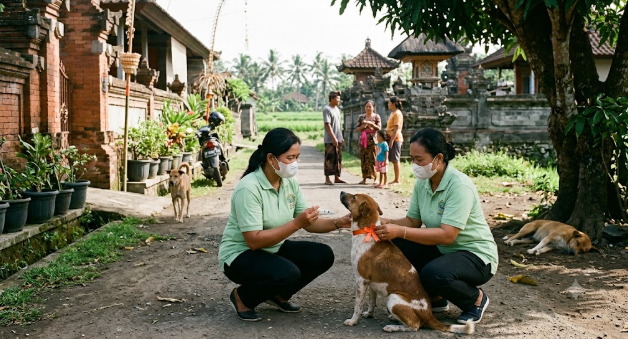
Bali rabies laws make the government legally responsible for controlling rabies and administering mass vaccinations. However, under Indonesian law, rabies control is structured as a shared responsibility between the government (providing public health systems, surveillance, and free mass vaccines) and individual animal owners (ensuring their animals are vaccinated, restrained, and not abandoned).
What does this exactly mean?
Indonesian law treats rabies control as a dual-track obligation: the government builds and maintains the public health defence system, while individual pet owners must maintain control over their domestic animals.
So, to be precise: The Government’s Role is Macro Management. First comes Vaccine Provision and Infrastructure, supplying free anti-rabies vaccines for animals (VAR-HPR) and human post-exposure prophylaxis (VAR/SAR for bite victims at Rabies Centres). Then comes Epidemiological Surveillance, where they track bite cases, map red-zone areas, test brain samples of suspected animals, and declare emergency zones. And the last is Mass Campaigns, where they organise island-wide vaccination drives, fund field veterinary teams, and establish village alert networks (TISIRA).
That last one deserves its own explanation. TISIRA (Tim Siaga Rabies), Rabies Alert Team is an official, village-level task force created by decree (SK Perbekel) to decentralise rabies control right down to the neighbourhood level. Instead of waiting for provincial teams from Denpasar to handle local problems, TISIRA acts as the local frontline defence in every village (Desa).
A local TISIRA team typically consists of the Village Head (Perbekel) and Banjar Chiefs (Kelihan Banjar), Customary Village Leaders (Desa Adat), local health cadres (Kader Kesehatan) and volunteers. Also, community police and military officers (Bhabinkamtibmas and Babinsa).
So What TISIRA Actually Does on the Ground starts with Dog Census and Mapping, where the members go door-to-door in their own banjars to count the total number of dogs (both owned and stray) so veterinary services know exactly how many vaccine doses are required.
Next comes Guiding and Assisting Vet Teams. When government vaccinators arrive, TISIRA members act as local guides. They know where stray packs hang out, who owns which dog, and help catch or hold nervous animals.

Then they serve as First Responders for Animal Bites. If a resident gets bitten, TISIRA immediately directs the victim to the nearest Rabies Centre (Puskesmas) for human shots, while simultaneously locating and isolating the biting dog for a mandatory 14-day observation period.
Lastly, Enforcing Village Customary Rules (Awig-Awig / Parerem), where TISIRA works alongside traditional customary leaders (Desa Adat) to enforce local rules. They issue warnings or customary fines to residents who dump unwanted puppies or allow unimmunised dogs to roam freely in public spaces.
Now we start to have an interesting conversation here… The government is responsible for a “Vaccination Campaign” (Kampanye Vaksinasi), which is an operational term for a massive, coordinated field action. It means “boots-on-the-ground” medical intervention.
So when the government executes a mass rabies drive in Bali, they are performing direct, practical actions. They go Direct Door-to-Door Injections (Jemput Bola), where teams of government veterinarians and animal health technicians physically walk through neighbourhoods, entering home yards and searching street alleys to inject dogs and cats directly. Behind that sits Free Vaccine Supply and Logistics, where the government purchases, stores in cold-chain refrigeration, and distributes hundreds of thousands of animal rabies vaccine doses (VAR-HPR) every year, along with syringes, gloves, and restraint tools.
They also set up Temporary Banjar Clinics, where government vet teams place temporary posts at local Banjar (community) halls on designated days, inviting residents to bring their animals for free shots and immediate health checkups.
Then the vaccinated dogs are tagged with coloured collars or plastic ribbons so field teams know which animals are protected, and each vaccination is recorded into iSiKHNAS (Indonesia’s Integrated National Animal Health Information System). For the ones the teams cannot reach, they bait street dogs with oral vaccines. For skittish, feral, or unowned stray dogs that run away from nets, government teams distribute Oral Rabies Vaccines (ORV) hidden inside edible baits dropped in areas where stray packs gather.
I am calling out the elephant in the room now.
There is a massive chasm between government policy written on paper and the reality on the ground in Bali.
What was outlined previously represents the official regulatory framework and government press releases. On the street, anyone working in animal rescue or ground-level welfare knows the daily execution tells a completely different story. This I personally fathom and acknowledge. NOW… let us peel it layer per layer.
1. TISIRA, Censuses, and Village Enforcement: Paper vs. Reality
Is the Dog Census Happening?

On Paper: The government claims over 400 village-level TISIRA teams perform dog counting. But the Ground Reality is that systematic door-to-door dog censuses almost never happen in practice. Government population data relies mostly on rough, outdated estimates. This is precisely why veterinary teams routinely run out of vaccine doses midway through a village or vastly miscalculate required supplies.
Do TISIRA Teams Have Offices? To be surprised, well… I am not surprised, like, at all. No. TISIRA is not a formal institution with a physical office or dedicated staff. It is simply an ad-hoc title given to existing village cadres, Kelihan Banjar (hamlet heads), and local volunteers.
So, if a resident is bitten, there is no “TISIRA Office” to visit. Victims go straight to a local Puskesmas or hospital, or rely entirely on independent local rescuers for help. In most banjars, residents have no idea who their designated TISIRA members are; or if the team exists at all beyond a signed piece of paper. IF… IF the paper ever existed.
Which brings me to Mass Culling vs. 14-Day Observation.
Well, On Paper, official guidelines state that biting dogs should be quarantined and observed for 14 days. BUT, and AGAIN, the Ground Reality is that the default reaction by local authorities (Distanpangan / animal control) during a rabies panic is mass culling (eliminasi). Field officers frequently use strychnine poison or blowdarts to sweep and kill healthy, community-fed, and even vaccinated dogs in the surrounding area rather than setting up proper quarantine or testing.
And regarding Awig-Awig and Fines for Dumping… the tragedy and where it all started, the Ground Reality is that fining people for dumping unwanted litters is virtually non-existent in 95%+ of Bali villages. While a handful of pilot villages drafted customary rules (Awig-Awig) under foreign NGO guidance, daily enforcement does not happen. Puppies are dumped at markets, rivers, and garbage dumps daily with complete impunity.
Up to this point, the government deliberately breaches the regulation without any consequences, issues a different and cruel so-called solution, mass culling, and keeps blaming the dogs and the rescuers without any remorse, projecting their incompetencies onto those who actually do the unpaid work for them.
Then comes the question, How Often Do Mass Rabies Drives Actually Happen? Well, the Official Claim is “annual mass vaccination drives.” And AGAIN (just count how many AGAINs since the beginning of my article), the Ground Reality is that execution is sporadic, reactive, and underfunded. A banjar might see a government vaccination team once, only for officers to disappear for two or three years until a human rabies death makes the news in that regency. Long-term, consistent door-to-door coverage is rarely maintained, leaving massive immunity gaps across districts.
You have read about iSiKHNAS above, so what is that, and Can You Access It? This is even my million dollar question.

What is it? iSiKHNAS (Sistem Informasi Kesehatan Hewan Nasional) is an internal, web-and-SMS-based national reporting database used by the Ministry of Agriculture to track livestock and animal diseases across Indonesia. As for Accessibility, it is private, and you cannot access it as a citizen or rescuer. It is a closed government portal, strictly restricted to registered government veterinary officers and livestock personnel.
So of course, there is no Real Impact on the Ground, and virtually zero visibility for rescuers or the public. It functions primarily as an internal bureaucratic tool so local officials can log data and send reports upstairs to Jakarta. It does not provide real-time public tracking, nor does it fix vaccine shortages or prevent indiscriminate culling on the street. Personally I am amazed by the government effort that has actually done the minimum for a massive and huge ongoing situation in Bali.
You certainly also read my writing in previous lines about Oral Rabies Vaccines (ORV) and The Sterilisation Failure, so let me finish that thought. The ORV Reality is that it is NOT an active island-wide programme. The deployment of Oral Rabies Vaccine baits in Bali was merely a temporary, small-scale pilot project (conducted around 2021 to 2022 in select trial zones in Buleleng and Karangasem by the FAO and international partners). It is not currently deployed at scale across Bali streets.
On top of that sits The Tracking Problem. During trial runs, placebos contained temporary blue dye that stained the dog’s mouth briefly to verify ingestion. There is no permanent physical tag, collar, or ear-notch applied to feral dogs eating ORV baits in the wild. Premature execution, premature temporary results, and wasted.
All of which leads to The Missing Link: Mass Sterilisation (CNVR), the programme that I personally support and urge. Because vaccination without high-volume sterilisation is a losing battle. Please read my article about Catch-Neuter-Vaccinate-Return , because the government spends almost no budget on Catch-Neuter-Vaccinate-Release (CNVR), and unsterilised street and community dogs reproduce rapidly. Within 6 to 12 months, a freshly vaccinated population is outnumbered by new, unvaccinated litters. The heavy lifting of population control in Bali falls almost entirely on private animal shelters, independent rescuers, and charity-funded spay/neuter clinics, not government infrastructure.
This is the time the government understood and applied their own laws and regulations before pushing them onto its citizens. It is not about the unfairness, simply about the moral standard as human beings together as a population living in Bali.
Which is why the Governing Laws and Legal Wording matter here, because several national and provincial regulations explicitly lay out government mandates and public obligations regarding rabies in Bali:

National Level: UU No. 18 / 2009 jo. UU No. 41 / 2014
Under the Law on Livestock and Animal Health (UU Peternakan dan Kesehatan Hewan), rabies is designated as a Penyakit Hewan Menular Strategis (Strategic Infectious Animal Disease / Zoonosis).
Their own Government Mandate in Articles 42 through 44 states that the Central Government and Regional Governments are obligated to execute prevention, control, and eradication measures for strategic animal diseases. This includes providing vaccines, establishing emergency response protocols, and carrying out surveillance.
Regional Level: Peraturan Daerah (Perda) Provinsi Bali No. 15 Tahun 2009
This is the primary legal foundation specifically governing rabies control across all regencies in Bali. Pasal 4 and 5 (Scope) mandate that rabies control is carried out by the Bali Provincial and Regency Governments through systematic prevention, control, eradication, and surveillance.
Then Pasal 6 (Vaccination) mandates PERIODIC mass vaccinations of Rabies Transmitting Animals (HPR) organised directly by the Government.
WHILE Pasal 7 and 16 (Owner Obligations) require pet owners to vaccinate their animals annually, maintain proper care, prevent animals from roaming freely in public spaces without leashes, and report any bite incidents.
Alongside that sits Regional Level: Perda Provinsi Bali No. 5 Tahun 2023, Pasal 28, which prohibits abandoning pets, letting animals roam unattended in public areas, abusing animals, and trading or circulating dog meat.
AGAIN, yes… AGAIN, those regulations without implementation and minimum execution.
NOW…
The Owner’s Legal Duties sit at the Micro Management level, where under Perda Bali No. 15 / 2009 and Perda Bali No. 5 / 2023 (Pasal 28), owning an animal carries strict legal obligations:
- Confinement (Pengandangan / Perantaian): Owners are strictly prohibited from letting their dogs roam freely in public spaces without supervision or a leash. Please read and understand the meaning of supervision.
- Mandatory Annual Vaccination: Owners must ensure their pets receive yearly rabies booster shots and hold an official vaccination card. This can be achieved if the government really understands and implements the regulations in the first place; those who have no clue what to do or have no knowledge about it can be informed and take care of their dogs better.
- Prohibition of Abandonment: It is illegal to abandon pets or dump unwanted puppies on streets, beaches, or near markets. Yet, no firm implementation, the law is valid only on paper. Uncountable abandoned pups still happen to the second I typed this article.
- Civil and Legal Liability: If an unconfined pet bites a person, the owner bears financial liability for medical treatment and can face administrative or legal penalties under public order ordinances. And firstly, the government must be a good role model to start with. But in this matter, the law is harsh on the weak and lenient on the powerful.
That covers owned animals, which leaves The Legal Status of Stray Dogs.
Under Indonesian law (UU No. 18 / 2009 jo. UU No. 41 / 2014 and Perda Bali No. 15 / 2009), animals fall into two practical categories: owned animals (hewan peliharaan) and unowned/stray animals (HPR tidak bertuan / liar).
In Bali, however, a significant portion of dogs fall into a grey category: semi-owned community dogs. These are animals that roam freely, fed intermittently by local banjars or shopkeepers, but have no registered owner claiming legal responsibility.

Then, Who is Legally Responsible for Stray Dogs?
The State and Local Governments bear full legal responsibility for unowned stray dogs.
When an animal has no private owner to enforce mandates against, Articles 42 to 44 of UU No. 18/2009 delegate the duty of disease control, rabies vaccination, and population management directly to the Provincial Agriculture Department (Distanpangan), Regency Livestock Services, and local village governments (Perbekel and Desa Adat).
But even with that responsibility written down, these dogs still remain strays and are possibly targeted for the next mass culling.
Practical Implementation: How Stray Dogs Are Handled in Bali
Managing unowned dogs in Bali relies on a combination of veterinary field interventions, customary village laws, and multi-sector partnerships. Still, personally I support and recommend Catch-Vaccinate-Release (CVR) and Oral Vaccines, where the field teams from the Department of Agriculture, often working alongside animal welfare organisations, catch stray dogs in public areas to vaccinate and tag them. To reach skittish or feral street dogs that cannot be manually netted, the government utilises Oral Rabies Vaccine (ORV) concealed inside edible baits.
Alongside that comes Humane Population Control (Sterilisation). Rather than mass culling, official government guidelines emphasise Catch-Neuter-Vaccinate-Release (CNVR) to stabilise stray dog populations and maintain vaccinated pack boundaries.
Of course Village Customary Regulations (Awig-Awig / Parerem) must be strictly upheld. Because state law can be difficult to enforce at the street level, the provincial government must actively encourage traditional customary villages (Desa Adat) to enact local laws. These awig-awig rules levy immediate customary sanctions or fines (often paid in rice or money) against residents caught dumping puppies or allowing owned dogs to join stray packs.
Next, Village Rabies Teams (TISIRA) must actively monitor stray packs in their neighbourhoods, report unvaccinated litters, track bite incidents, and assist mobile vaccination units.
Lastly, Selective Elimination vs. Euthanasia. Indiscriminate mass culling of healthy strays is legally discouraged under regional welfare standards. However, under emergency veterinary protocols, animals showing clinical symptoms of rabies (sangat dicurigai rabies) or confirmed positive via diagnostic testing are humanely euthanised by authorised officers to prevent human casualties, and even this must go through very thorough steps to reach this last verdict.
If you are in Bali and you feed a street dog, keep a dog, or have simply had enough of watching this repeat, here is what actually moves the needle.
Sterilise the female dogs around you. One female is where every future litter starts.
Report dumping in your banjar. Silence is what keeps it costless.
Support the people doing the work with no budget and no office.
I run sterilisation, vaccination and treatment for street dogs in Tabanan and beyond, funded mostly out of my own pocket. If you can help, or if you need help for a dog near you, message me.
📩 WhatsApp
🌐 abyssdome.com
Dear Bali government, please read my article.
If you need my help, I am available and reachable.
Sources
- Peraturan Daerah Provinsi Bali Nomor 15 Tahun 2009 tentang Penanggulangan Rabies, published by the Bali Agriculture and Food Security Department
- Peraturan Daerah Provinsi Bali Nomor 5 Tahun 2023 tentang Penyelenggaraan Ketertiban Umum, Ketenteraman Masyarakat, dan Pelindungan Masyarakat, Bali Provincial Legal Documentation Portal (JDIH)
- Distanpangan Bali on Pasal 28 and rabies population control through sterilisation, 2025 mass vaccination release
- Ministry of Agriculture Legal Database (JDIH Kementan) for UU No. 18/2009 jo. UU No. 41/2014 on Livestock and Animal Health
- Bali Provincial Government announcement that 404 village-level Rabies Alert Teams have been formed, Bappeda Bali, 7 June 2024
- Buleleng Agriculture Department overview of TISIRA roles and training
- Buleleng Regency on strengthening vaccination and the role of TISIRA
- Bali Post on multi-helix collaboration against rabies, including village budget commitments for TISIRA, 16 September 2024
- iSiKHNAS, the national animal health information system login portal
- Mongabay Indonesia on Bali hosting Indonesia’s first oral rabies vaccine trial, December 2021
- Buleleng Animal Health Office on the ORV immunogenicity study in Kelurahan Banyuning